
Learn How Longer Pallet Forks Improve Safety and Efficiency on Material-Heavy Jobsites
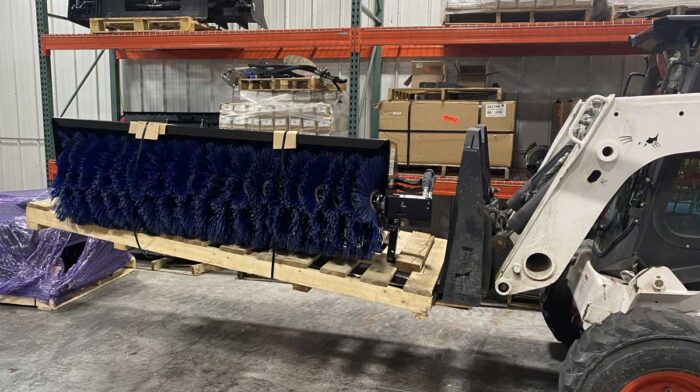
Walk onto almost any construction site, and you will find a set of pallet forks mounted to a skid steer or compact track loader. They are one of the most common attachments in the industry — used daily to unload trucks, stage materials and move everything from brick to bundled lumber.
Because pallet forks are so common, they are often treated as a commodity. Many machines arrive with standard 42- or 48-in. forks, and that becomes the default setup. When a load extends beyond the tips, operators slow down, reposition or, in some cases, slide on fork extensions to gain extra reach.
In many situations, that approach works. But in material-handling-heavy applications, “making it work” is not the same as spec’ing it right. For contractors who routinely handle long or oversized materials, stepping up to 60- or even 72-in. forks can deliver better load stability, jobsite safety and operational efficiency.
When Standard Forks Reach Their Limits
Standard fork lengths exist for a reason. 42- and 48-in. forks are well suited for most palletized materials. They offer good maneuverability in tight spaces and match the needs of general construction, landscaping and light material handling.
However, certain applications push beyond what standard forks were designed to support. Contractors handling bundled lumber, engineered wood, roof trusses, precast concrete, steel, pipe or oversized pallets often find that 42- or 48-in. forks simply do not provide enough support.
When only part of the load rests on the tines, the unsupported portion creates a cantilever effect. Weight shifts forward, increasing stress at the fork heel and moving the load center farther from the machine. The result is reduced stability and diminished lifting capacity.
In these situations, longer forks are not about convenience. They are about control.
Fork Extensions vs. Fully Engineered Longer Forks
When loads extend past the length of standard pallet forks, fork extensions are often the first solution. Extensions are relatively inexpensive and easy to install, and, for occasional use, they can provide the extra reach needed to complete a task.
But extensions have limitations. Adding an extension does not increase the rated capacity of the fork. By increasing the load center, extensions can actually reduce safe lifting capacity. The added leverage places more stress at the fork heel and carriage as well, which can introduce additional deflection under load.
For contractors who regularly handle long materials, a fully engineered longer fork offers a more stable solution.
Stability starts with support.
Longer forks are purpose built from the ground up to handle extended loads. Some severe-duty configurations are rated at up to 6,000 lbs, providing both length and capacity in a single integrated design. Reinforcement is engineered into high-stress zones such as the heel and carriage interface, and heel thickness and taper profiles are designed to manage the additional leverage created by extended tines. This purpose-built construction allows contractors to gain length without compromising structural integrity or operating within manufacturer ratings.
That engineering matters because stability starts with support. When more of the load rests directly on the tines, weight is distributed more evenly across the fork surface. The result? Loads are less likely to flex, bow or tip forward during lifting and transport. For long materials such as trusses or bundled lumber, full-length support can significantly reduce movement during acceleration, braking or turning.
Reduced movement also means reduced risk. Every time a load shifts, operators must compensate with steering, tilt adjustments or slower travel speeds. Longer forks help create a more predictable lift, allowing operators to maintain control without constant correction.
Fewer Adjustments, Less Exposure
Short forks often require multiple attempts to position a load correctly. Operators may partially lift the material, set it back down and reapproach to gain better balance. Each reposition introduces additional machine movement and additional exposure to shifting weight.
Longer forks can reduce that cycle. With more surface area under the load, operators are more likely to achieve proper balance on the first attempt. That translates to fewer adjustments, less back-and-forth movement and fewer opportunities for error.
Best practices still apply. Loads should remain low during transport. Fork spacing should match pallet width. Operators should understand how changes in load center affect rated operating capacity. But when fork length aligns with the material being handled, those best practices become easier to follow consistently.
Efficiency on Material-Heavy Jobsites
Safety gains often translate directly into efficiency gains. When loads are properly supported, material damage decreases. Long lumber is less likely to crack or splinter under its own weight. Pallets are less likely to break at the edges. Precast or masonry products experience less stress during lifting and staging.
Time savings follow. Fewer repositioning attempts mean faster unloading. Better balance means smoother travel across the jobsite. In high-volume environments such as lumber yards, roofing supply operations or precast yards, those incremental time savings add up quickly.
Longer forks can also support fleet optimization. Instead of assigning a larger machine or secondary piece of equipment to manage long loads, contractors may be able to handle a wider range of materials with a properly equipped skid steer or compact track loader. In some cases, the right fork length can eliminate the need to reposition materials with a telehandler or move a second machine into place, reducing equipment moves and improving overall site flow. That flexibility is especially valuable for operations running lean fleets where every machine must perform multiple roles.
A Strategic Spec Decision
Pallet forks may be one of the simplest attachments on a jobsite, but fork length should never be an afterthought. The right length directly affects stability, load control and overall efficiency.
Contractors should evaluate how often they handle extended materials, how much time is spent repositioning loads and whether damaged product or slow staging is quietly affecting the bottom line. They should also consider carrier size and rated operating capacity. Longer forks add weight and shift the load center, making machine compatibility a critical part of the decision.
Working closely with attachment manufacturers or dealers helps ensure fork length, capacity and compatibility align with operational needs. When fork length matches the application, safety improves and productivity follows.
Darin Gronwold is a product manager for Ignite Attachments.


Comments are closed here.