
Solutions to Help Shrink the Skilled Worker Gap
Of the numerous challenges construction companies have been facing over the past few years, the workforce shortage has consistently remained at the top of the list. There are a few reasons why.
“We have an aging workforce that is retiring faster than we are getting new workers in,” said Amanda Long, executive vice president of revenue at Industrial Training International (ITI). “It is also difficult to attract those new workers. We have to get young people, as well as those whose jobs have recently been impacted by automation, to see that craft work in the construction industry is a great career.”
Three-Pronged Approach
More effective employee recruiting is just one part of the workforce shortage solution. According to Long, construction firms must also develop more efficient onboarding methods and accelerated learning tools.
There is no one size fits all when it comes to the learning tools either.
“People need different modalities of learning to make sure the skills are known and understood,” Long said. “That’s why we like to focus on a blended learning approach, a combination of instructor-led training, online training and simulation training.”
ITI unveiled several new training solutions at CONEXPO-CON/AGG 2026, building on a broader portfolio designed to help employers assess, train and continuously improve their hoisting and material handling programs. That portfolio includes instructor-led crane and rigging courses delivered at ITI training centers or on customers’ jobsites; online and on-demand training through the ITI Learning Hub; NCCCO certification preparation and exams; virtual reality crane simulation; and consultation and audit services for organizations seeking to strengthen safety, compliance and workforce capability.
Through the ITI Learning Hub, companies can access a large library of crane, rigging and load-handling content, including online courses, certification test preparation, technical lectures from subject matter experts, manufacturer product training modules, instructor-led course options and VR/AR integrations. The platform also provides learning paths, registration and transcript management, certificates, qualification cards, analytics and reporting, giving employers a more scalable way to manage training across teams and locations.
ITI’s VR crane simulator adds another layer to that blended approach, giving operators a controlled environment to build skills, practice decision-making and experience jobsite scenarios before moving to live equipment. The simulator includes more than 1,000 training scenarios across 12 crane and equipment models, as well as construction hazard identification training that supports safer, more consistent operator development.
Labor-Saving Equipment
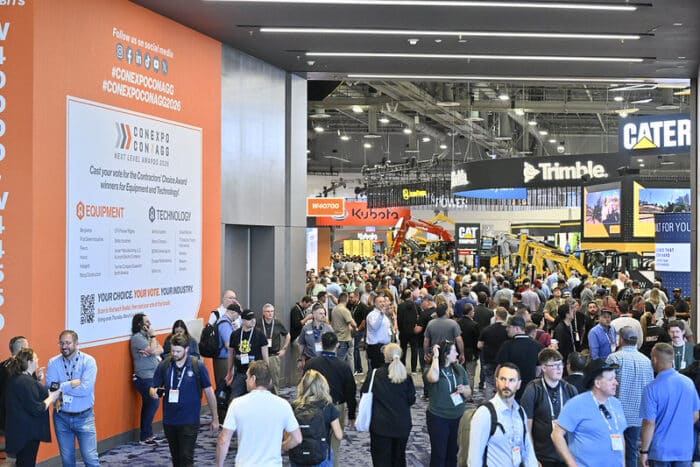
According to Dana Wuesthoff, show director for CONEXPO-CON/AGG, it was fascinating to walk around the show this past March and see how much new equipment is being designed with the worker shortage in mind.
“Equipment features that help reduce training requirements, labor needs and safety risks are helping construction companies do more with the employees they have,” Wuesthoff said.
Vacall is one example. The company unveiled a new vacuum excavator that’s light enough for employees to operate without needing to obtain a CDL.
“That makes this vacuum excavator accessible to a wider range of operators, while also reducing training time and onboarding costs,” said Tod Ebetino, vice president of sales and marketing. “Simple, intuitive and logically arranged controls keep operation straightforward and efficient. Operators can simply pull onto a jobsite, park and excavate. It’s truly that simple.”
Remote-controlled equipment is another way to tackle the worker shortage. Not only does it appeal to a different type of worker, but it can also provide a significant boost to both safety and productivity.
Remote-controlled slope mowers are a good example. Operating traditional riding equipment on slopes can be very risky. Remote control removes that risk on the operator. Energreen America has introduced a new slope mower that can handle steep gradients up to 61 degrees. The remote control system has a range of nearly 500 ft, allowing the operator to remain at a safe distance from the actual work environment.
Reducing labor needs doesn’t have to be as involved as remote-controlled or autonomous equipment either. ZipLevel has been helping construction pros measure elevation differences and level surfaces with half the labor. This one-person tool recently got its first major electronics upgrade in 30 years, largely driven by a desire to make the tool even easier to use and more reliable — two hallmarks of helping construction firms do more with the workers they have, which is a key to overcoming the ongoing workforce shortage.
This article was provided by CONEXPO-CON/AGG. Click here for more info.





Comments are closed here.