
How to Select and Size the Right Thumb for Your Excavator
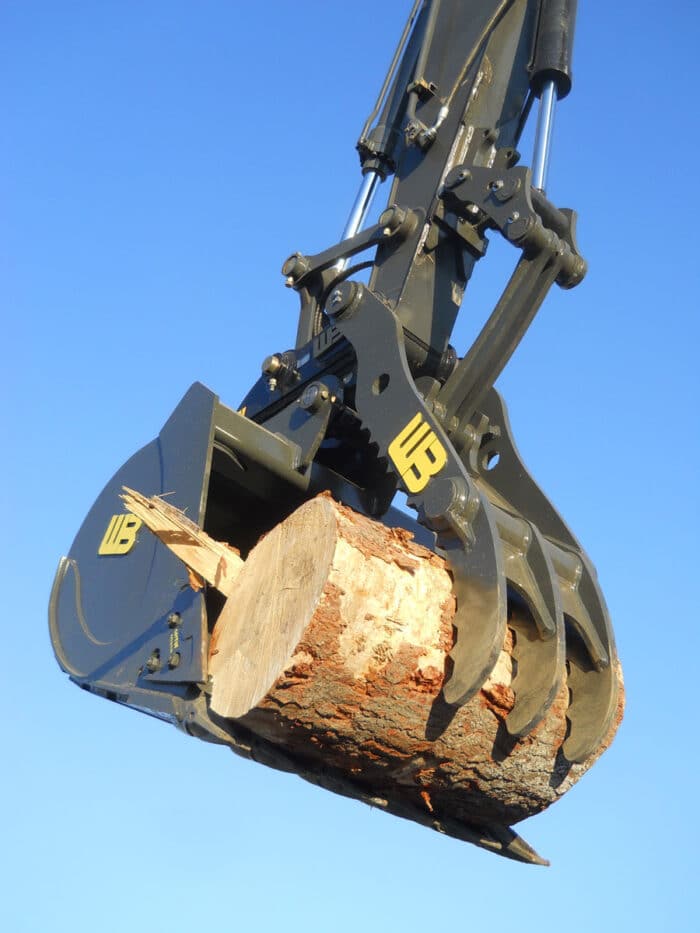
An excavator without a thumb limits what the machine can do. With a bucket alone, your excavator is a high-production digger, but add a thumb, and now it’s also a precision-focused material handler. Whether you’re meticulously placing armor stone or clearing awkward demolition debris, the configuration of your thumb dictates the efficiency of your entire cycle.
Much like the human thumb, an excavator thumb allows your equipment to grasp, hold and move a variety of materials that may be challenging to pick up with only a bucket. The bucket and thumb make a dynamic duo that increases the versatility — and therefore profitability — of your machine.
One of the most common mistakes in attachment selection is oversizing. Every additional pound of steel at the end of the stick directly reduces your machine’s net lifting capacity and breakout force. The right attachment isn’t the biggest available, it’s the one properly matched to the application.
Let’s try to simplify your options and break down the differences in the three main thumb types.
1. Stick-Mounted Thumb: The Universal Starter
Often the choice for compact utility machines or rental fleets, a stick-mounted thumb is valued because it’s an easy-to-use, low-cost option. Because it operates on a separate axis from the bucket, it does not maintain a constant mesh through the rotation. Think of it as more like a pair of scissors than a pair of pliers.
How It’s Sized: Base this thumb size on the narrowest bucket in your machine class. If you go by a wider bucket, it can create lateral forces that twist the stick. Since it’s off the shelf, you may have to trim the tines to fit the tip radius of your bucket (the distance from the center of the pin to the tip of the tines).
Pros: It doesn’t necessarily require hydraulics, so it can meet you where you’re at in terms of equipment. If you don’t have a quick coupler, you can use the thumb then swap buckets without completely removing the thumb, and that’s going to be a huge time-saver. It’s also easily removed by pulling two pins, which is good for those who only occasionally need a thumb.
Cons: It doesn’t have a full range of motion (about 130 degrees of rotation) and is going to require repositioning. This isn’t a custom solution, so you’ll miss out on a lot of use cases. And if you have to trim the tines on a two-tine or multi-tine thumb, you’re adding several steps to the prep work and probably a few hours of shop time. It can also affect your warranty or lead you to need new operator training. If done incorrectly a thumb that is too short will fall in the bucket and lose grip, while one that’s too long risks striking the boom or cab.
Who It’s For: This is an ideal solution for contractors who use a thumb occasionally for basic material handling, utility or demolition work but don’t want the weight or cost of a permanent hydraulic fixture.
Don’t Buy This: If you already have a quick coupler system, plan to use a thumb more than once a day for a short period or are hoping to grow your business to bid on a greater variety of projects, skip this one and move straight to the next.
2. Main Pin Hydraulic Thumb: Proven Versatility
This is the industry benchmark for general construction and what you’ll most commonly find on compact equipment. By sharing the same axis as the bucket, the thumb and bucket work in synchronized action — more like the pliers mentioned before. It costs more, but you get more.
How It’s Sized: This is an exercise in geometry that looks at the tip radius, tooth mesh and coupler offset. Where you didn’t worry about tooth mesh on the previous, here it matters how wide the bucket and how many teeth to avoid uneven wear or jamming. If you plan to add or change a quick coupler later, get your measurements before ordering a thumb.
Pros: These are engineered to match the specifics of your bucket and coupler configuration. This ensures a perfect match and superior gripping force for the widest variety of tasks. You can have yours built entirely custom or select a standard offering in stock for the most common configurations.
Cons: With roughly 120 degrees of rotation, a little less than a stick-mount, it cannot track the bucket through its entire range of motion. At maximum reach, you’ll have to use the bucket to pull material closer before the thumb can engage. These thumbs also take more time to take on and off compared to the lower tier, which will be an adjustment if you’re just moving up.
Who It’s For: The construction generalist who is using a thumb regularly to maximize machine hours benefits most from this thumb. It could be that you’re not ready to commit to a fully custom solution or that the next tier is actually too custom for the wide variety of work you’re doing.
Don’t Buy This: If you plan to take the thumb off daily or you’re operating in situations where you need to reach way, way out, go down or up a tier.
3. Progressive Linkage (Pro Link) Thumbs: Designed for Precision Handling
Consider this the standard for certain industry segments where attachment efficiency hits the bottom line directly and where you’re looking to assure the safety of crews in extreme conditions. It makes operators look like rock stars in precision applications.
How It’s Sized: These require the most measurements. On top of what you did with the others, you need a stick measurement between the main pin and dead pin, measurements of the pinch points between the teeth and a decision on a two-tine or three-tine option. You pretty much need to have a coupler already to order this. And you’ll need to provide auxiliary hydraulic specs.
Pros: These thumbs provide up to 180 degrees of movement. The thumb tracks the bucket through its full range of travel, allowing for precise pickups even at full extension. It’s a time saver that cuts out repositioning and machine travel.
Cons: The extra linkage and heavier construction mean these are the heaviest options on the market. The added weight can actually disqualify this option for smaller machines.
Who It’s For: Demolition contractors running multiple applications daily will love this thumb. Operators specializing in deep trenching and utilities, shoreline and waterway management, high-reach demolition or delicate environmental applications can also benefit due to the full range of movement.
Don’t Buy This: If you’re doing basic handling or a high variety of work, it’s overkill.
A stick-mounted thumb isn’t necessarily “worse,” and a progressive linkage thumb isn’t necessarily “better.” It all comes down to your equipment, your work, your goals today and in the future, and, of course, your budget. The best thumb for you depends on you.
Even if you’ve previously thought of a thumb as a luxury, they aren’t all priced like one and making the time to buy a thumb doesn’t have to be one. A manufacturer or local dealer can help you figure it out and then train your operators to use it. The right thumb for the right job can make work faster, easier, safer and more profitable.
Mike Noward is a marketing manager for Werk–Brau.


Comments are closed here.