
Learn How Small Articulated Loaders Became the Compact Equipment Category You Can’t Ignore
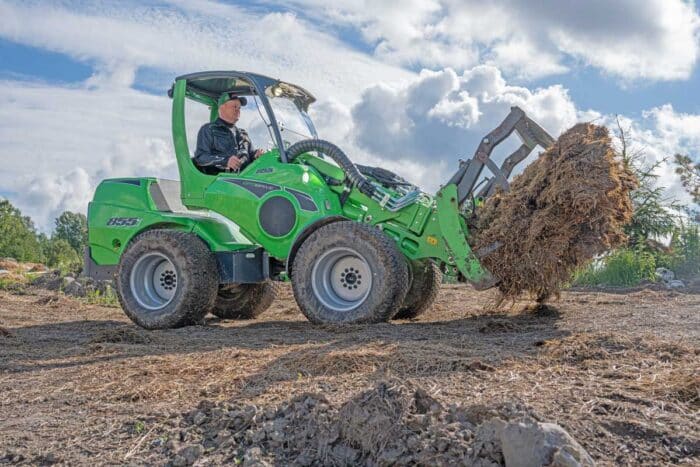
Not long ago, if you asked a landscaper, municipality or tree care pro what sat between a skid steer and a compact wheel loader, you might have gotten a blank stare. Today, the answer is clear: the small articulated loader — or SAL — and it’s one of the fastest-growing segments in compact equipment.
These ultra-compact, articulated wheeled machines combine the attachment versatility you’d expect from a skid steer with the surface-friendly footprint and maneuverability of a traditional wheel loader — all in a package often small enough to squeeze through a backyard gate. That’s a compelling pitch, and the market is responding. From solo landscapers to municipal crews, from horse farms to hardscape contractors, operators across industries are discovering that a SAL can do what other machines can’t — or won’t.
A Category on the Rise
The story of the SAL in North America is really two stories: a slow build, then a sudden surge. Specialized importers and niche brands had been selling small articulated loaders to tree care professionals and landscapers for years, but the segment stayed relatively under the radar — until the big OEMs showed up.
“Since the large-scale introduction of small articulated loaders in the early 2010s, the market has continued to grow,” says Chris Sleurink, owner of Intrepid/MiniLoaders.com, one of the country’s leading SAL importers. “This growth has been spurred on by larger manufacturers entering the market since 2020. Whereas previously the primary market was the tree care industry, we now see the market expanding to landscapers, construction companies and rental companies. Having more competitors has been a net positive for us — it broke the market open even further.”
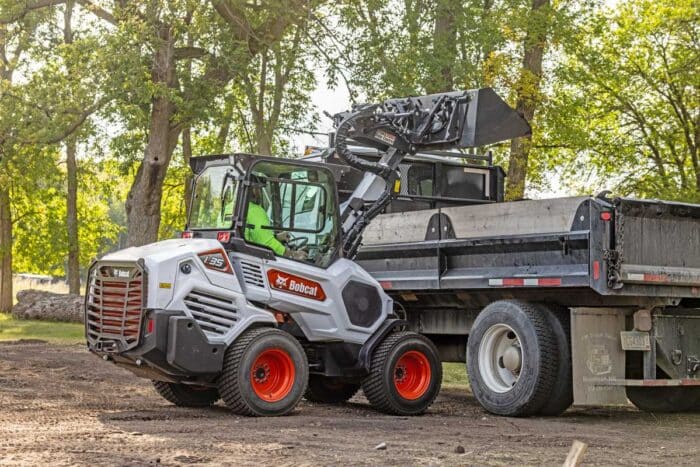
Bobcat introduced its L23 and L28 at CONEXPO-CON/AGG 2020. Case entered with its first three models at CONEXPO 2023. Avant Tecno USA, which has operated in North America since 2012 as an outpost of the Finnish company that pioneered the machine concept in 1991, has watched the landscape change in real time.
The tailwinds are structural. Urbanization is compressing jobsite footprints. Infrastructure investment is creating demand for surface-sensitive machines on finished pavement and turf. Municipalities are under pressure to do more with fewer crew members. And across agriculture, landscaping and property maintenance, the appeal of one machine that can do many jobs — rather than a fleet of single-purpose tools — is increasingly hard to argue against.
“Customers are increasingly focused on equipment that can improve efficiency, operate in tight spaces and work on finished surfaces with minimal impact,” says Ryan Anderson, product manager for subcompact equipment at Case Construction Equipment. “Small articulated loaders are designed to meet those needs.”
SAL vs. The Field: Why Not Just Buy a Skid Steer?
It’s a fair question. Skid steers are everywhere. Compact track loaders are even more popular now than their wheeled cousins. Compact wheel loaders cover the larger end of the spectrum. So where does a SAL fit?
The short answer: articulated steering changes everything. When a skid steer turns, it drags its tires laterally across the surface — fine on dirt, brutal on turf or pavement. A SAL’s articulating frame lets the rear wheels track the same path as the front, dramatically reducing surface scuffing. That’s not a minor convenience. On a high-value lawn or freshly laid hardscape, it’s the difference between a happy client and a very expensive remediation job.
Beyond surface protection, SALs offer operator-friendly advantages that matter on multi-hour shifts. Visibility — especially with front-mounted attachments and, in many designs, telescopic booms — is a key differentiator. So is comfort: a steering wheel rather than twin joysticks is more intuitive for operators who don’t live in a skid steer cab all day, and the open, often ride-on rear-seat configuration feels less fatiguing than an enclosed steel box.
“A SAL offers minimal ground disturbance on turf and finished surfaces, is more fuel-efficient, easier to maneuver in tight spaces and more comfortable for many operators to use throughout the day,” says Beau Slavens, president of Avant Tecno USA. “Visibility is also a major advantage — especially with 360-degree operator visibility, front-mounted attachment position and overall machine layout. Together, these features result in a much safer option for operators.”
Compared with compact track loaders, SALs are typically lighter and easier to trailer — an important consideration for contractors moving equipment between jobs. And compared with compact wheel loaders, SALs are smaller, more nimble and more deeply attachment-driven.
There are trade-offs. Tracked machines still hold an edge in soft, muddy or highly uneven terrain. And in applications demanding aggressive digging or heavy pushing — think demolition or land clearing with big spoil piles — a skid steer or CTL will still outmuscle the average SAL. But for the growing universe of jobs where delicacy, visibility and versatility matter as much as raw muscle, the SAL’s case is compelling.
The Lineup: Who’s Building What?
With the category now firmly on the radar of the major OEMs — and specialist importers holding their own against the newcomers — there’s no shortage of options for buyers. Here’s what each of our sources is bringing to market.
Avant Tecno USA
If there’s a brand that can claim to have been doing this the longest in the North American market, it’s Avant. Founded in Finland in 1991, Avant Tecno built its entire company identity around the compact articulated loader — this was never a product extension or a market hedge; it’s the whole business. The North American operation launched in 2012, and part of its mission since day one has been educating a market that, as Slavens notes, is still catching up to Europe in its familiarity with the concept.
“Once customers see the combination of lift-to-weight ratio, low surface impact, telescopic boom, articulation and attachment versatility, the fit becomes clear,” he says.
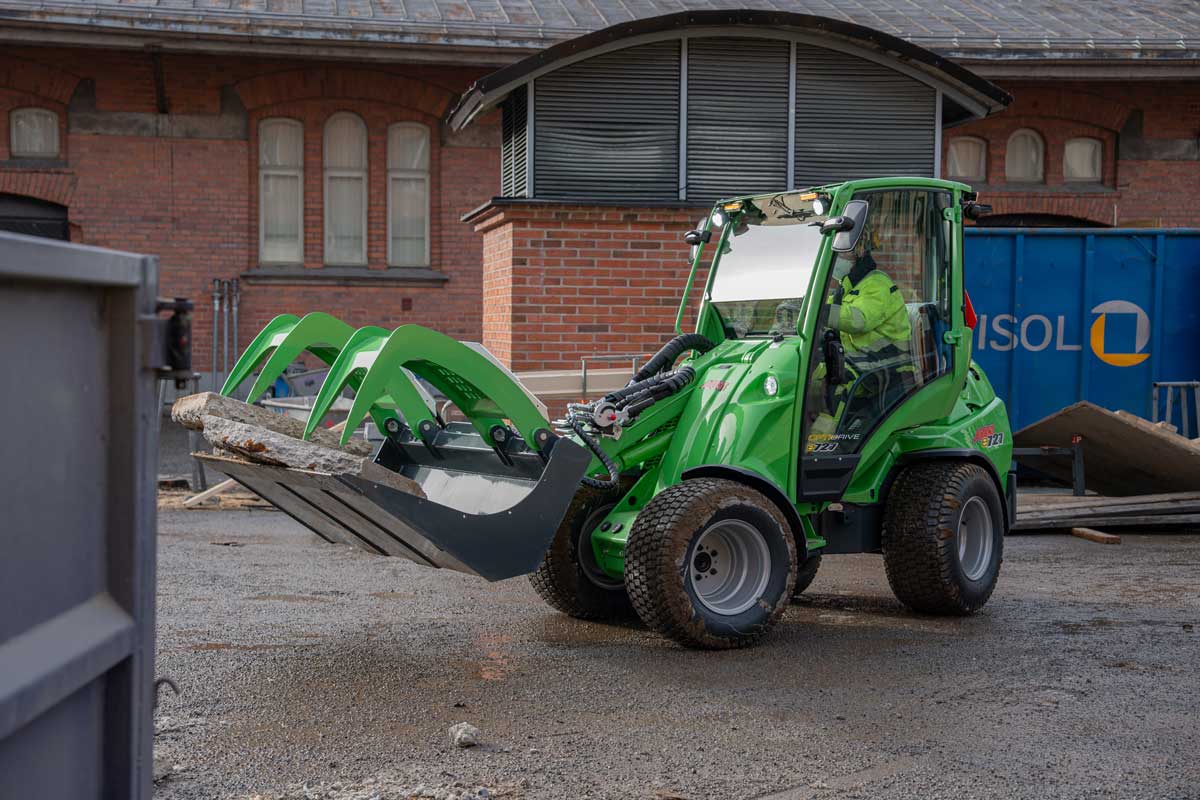
The current Avant lineup spans 16 compact articulated loader models — from the 200 series (772-lb lift capacity, ideal for lighter-duty private users) all the way up to the 800 series (4,190-lb lift capacity, the lineup’s peak performer). The 400, 500, 600 and 700 series fill the middle, with each step up delivering more lift capacity, greater lift height and higher speed.
The standout design feature across the range is Avant’s offset telescopic boom — a configuration that delivers added reach and flexibility without forcing buyers into a larger machine class, while also delivering what Slavens calls “unparalleled visibility of the attachment during operation.”
The headline addition for 2025-26 is the e727 — Avant’s latest battery-electric SAL — now available in North America. With a 3,100-lb lift capacity comparable to the diesel 735i, the e727 targets demolition, landscaping, construction and farming operations where quiet, zero-emission performance matters.
Bobcat
Bobcat came to the SAL category with institutional credibility — the company invented the modern skid steer loader and attachment-based tool carrier concept. So, when it turned its attention to articulated loaders, the industry paid attention. The L23 and L28 debuted at CONEXPO 2020, and the lineup has since grown to three models with the addition of the L35.
The L23, the most compact of the three, is built for tight residential and commercial sites — fenced yards, sidewalks, narrow access corridors. Its fixed lift arm keeps things simple and the machine’s footprint light. Step up to the L28 and you gain a telescoping lift arm and increased rated operating capacity, making it a better fit for palletized material handling and jobs requiring higher dump heights. At the top of the lineup, the L35 delivers the most capability: higher rated operating capacity, a longer telescoping arm, optional high-flow hydraulics for demanding attachment work and compatibility with Bobcat’s Machine IQ telematics platform.
The L35 also makes Bobcat’s strongest case for year-round productivity, with an available factory-installed enclosed cab with heat and air conditioning — a meaningful differentiator in markets where SALs might otherwise sit idle during cold or wet seasons.
Operating weights span from under 4,000 lbs to just over 6,000 lbs across the lineup, with horsepower ranging from approximately 25 to 57 — enough spread to address a genuine range of user profiles, from occasional-use rental machines to daily-driver production tools.
Case Construction Equipment
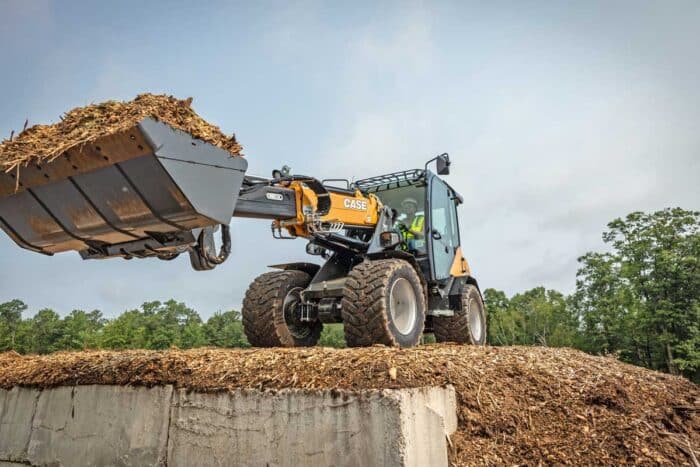
Case came into the SAL market with something its competitors couldn’t quite replicate: decades of construction-grade DNA. The company has a long history in compact and full-size wheel loaders, and its entry into the SAL segment — beginning at CONEXPO 2023 — reflects a deliberate strategy to extend that heritage into a smaller, more versatile package.
“Case’s experience in the larger construction equipment categories allows us to contribute to the subcompact industry by providing construction-grade equipment,” says Anderson.
That philosophy shows up in the design details. Case SALs feature an oscillating front section — a differentiator that adds comfort for the operator, reduces shock to the machine and load, and delivers superior traction and control across uneven terrain. The rear-positioned operator station improves visibility and increases tipping load, while the compact footprint lets Case machines maneuver in spaces, Anderson says, where other SALs simply can’t follow.
Three seasons in, Case now offers nine SAL models spanning 25 to 74 hp — a range that covers both diesel and electric powertrains, as well as standard and telescopic boom configurations. The newest addition is the SL27 TR, a telescopic-reach model that expands the lineup’s versatility for applications requiring greater dump height and material reach.
Intrepid/MiniLoaders.com
In a market now crowded with OEM entrants, Intrepid stands apart as a specialist importer — a company that’s been selling compact articulated loaders since before it was a trend. Sleurink’s operation, MiniLoaders.com, has marketed the Intrepid brand in the United States since 2018, importing machines manufactured and branded as Knikmops in Belgium.
The Intrepid lineup runs five models: the KM85, KM100 Tele, KM130 Tele, KM180 Tele and KM250 Tele. The smallest, the KM85, weighs just 2,000 lbs — making it the lightest mini-articulating loader available in the U.S. market. Each subsequent model adds roughly 1,000 lbs of operating weight, topping out with the KM250 Tele at 6,500 lbs and a lift capacity of over 4,000 lbs.
The best-seller in the lineup is the KM100 Tele — a 3,000-lb machine with a 1,750-lb operating capacity, powered by a 25-hp Kubota engine and fitted with a telescopic boom. It’s capable enough for real production work, light enough to be genuinely nimble and easy to transport.
Intrepid’s newest addition is the KM180 Tele, powered by a 43-hp Yanmar engine. Sleurink describes it as a machine that “perfectly bridges the gap between what we classify as a small articulated loader and a compact wheel loader.”
Two design features define the Intrepid identity. First: the entire lineup uses a rear-seated configuration, where the operator sits on top of the engine at the rear of the machine. This results in what Sleurink calls “almost zero tail swing” — the engine compartment doesn’t sweep out when the machine turns.
Second: Intrepid machines are built with all-steel frames and zero plastic body panels. Every colored steel panel is removable, providing maintenance access that Sleurink says outclasses the competition.
Brandon Jaynes is a freelance writer for Compact Equipment.


Comments are closed here.