
Selecting the Right Attachment for Land-Clearing Applications
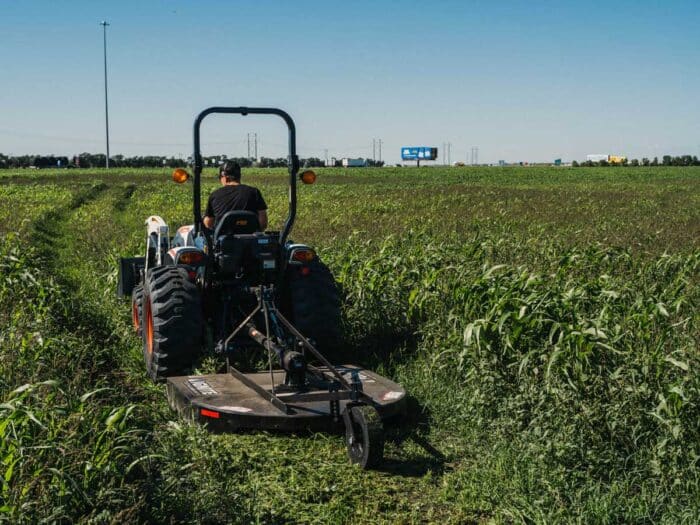
Tackling a brush-clearing project rarely goes exactly as planned. A site that looks like it just needs a quick cleanup can hide all kinds of surprises. Maybe it’s mostly tall grass and weeds. Maybe there are saplings mixed in. Maybe there are volunteer trees along a fence line or old stumps left behind from previous clearing work. Before long, what seemed like a simple mowing job turns into something much bigger.
That’s why choosing the right attachment for land clearing applications matters.
The good news is there isn’t a shortage of compact equipment options. A rotary mower, brush cutter, tree puller and stump bucket can all play a role in vegetation management, but they solve very different problems.
The trick is understanding where each attachment fits.
Need to Cover Ground Quickly?
Not every brush-clearing project calls for the biggest attachment available. In fact, if most of what you’re dealing with is grass, weeds, cattails and other light vegetation, a rotary mower will often get the job done faster than anything else.
Rotary mowers are built for productivity. Their wide cutting paths make quick work of trails, undeveloped lots, retention ponds and other large areas where the goal is to knock down vegetation and move on to the next task. Depending on the carrier and attachment, rotary mowers can typically handle material up to about 3 inches in diameter, making them a good fit for routine maintenance and lighter reclamation projects.
For contractors maintaining properties throughout the season, speed is often the biggest advantage. A properly sized rotary mower allows operators to cover a lot of ground in a short amount of time while producing a more uniform finish.
That doesn’t mean durability should be overlooked. Hidden rocks, stumps and debris have a way of finding mower blades when vegetation gets thick. Features like stump jumpers, chain shielding and driveline protection help reduce damage and downtime when conditions aren’t ideal.
Need to Tackle Dense Brush?
Eventually, every contractor runs into a property that’s gone beyond routine maintenance.
Maybe the site hasn’t been touched in years. Maybe brush has taken over fence lines and access roads. Maybe saplings have started competing with the grass. That’s when a brush cutter starts making more sense.
Think of a brush cutter as the next step up from a rotary mower. While rotary mowers excel at maintaining vegetation, brush cutters are designed to reclaim it.
Their heavier construction and aggressive cutting systems allow operators to tackle dense brush, woody vegetation and larger saplings. They are often used as a first pass on heavily overgrown properties, rights-of-way and undeveloped land. Crews can quickly clear access, improve visibility and expose obstacles that may need additional attention later in the project. Once the vegetation is down, operators can better evaluate whether additional removal work is needed.
Because brush cutters are frequently working in rough conditions, protection features become especially important. Reinforced decks, chain curtains, stump jumpers and hydraulic system protection can all help extend attachment life and reduce costly downtime.
Need to Remove Larger Trees?
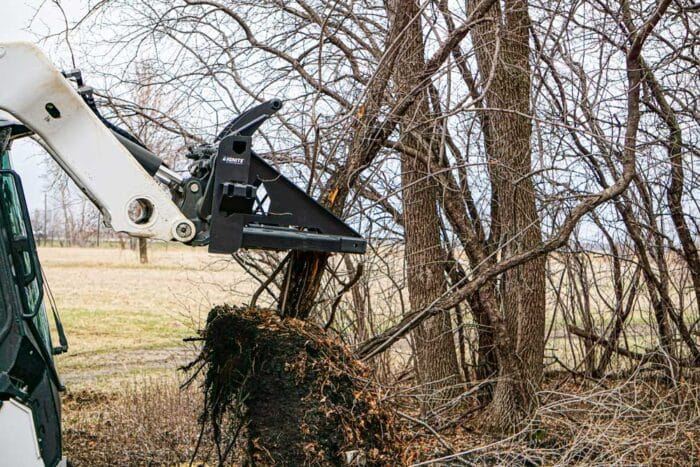
Sometimes cutting vegetation isn’t enough.
Ever cut down a volunteer tree only to repeat the work a year or two later? That tenacity is why tree pullers have become popular with contractors, acreage owners and land managers.
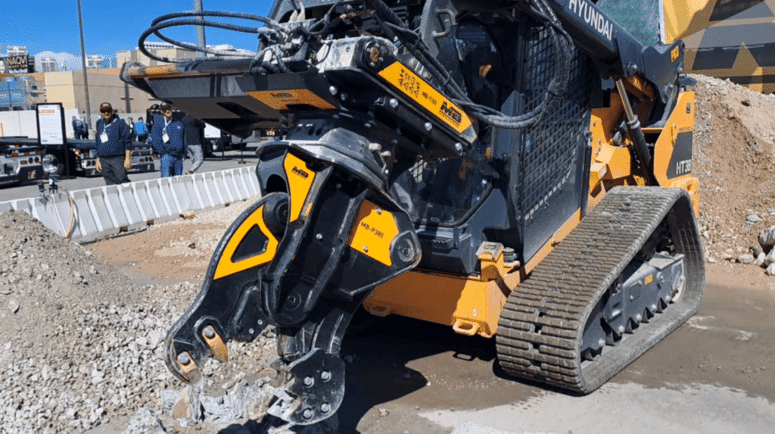
Tree pullers are designed for situations where vegetation needs to be removed, not just cut down. Using hydraulic jaws, the attachment grips the trunk and pulls upward, removing the tree and much of its root system in a single step. This helps reduce regrowth while eliminating the need for extensive digging.
Tree pullers are especially useful for clearing fence lines, removing invasive species, opening up building sites and thinning unwanted growth in areas where operators want to minimize disturbance to surrounding vegetation.
One of the biggest advantages of a tree puller is precision. Rather than clearing an entire area, operators can selectively remove problem trees while leaving desirable vegetation untouched. That’s particularly valuable on properties where aesthetics, erosion control or preservation of existing landscaping are important considerations.
Most tree pullers are designed to handle saplings and smaller trees, though exact capacity varies by model. Features like reinforced jaws, protected hydraulic components and integrated push bars can improve extraction efficiency while helping the attachment stand up to demanding applications.
Want Deep Removal Capabilities?
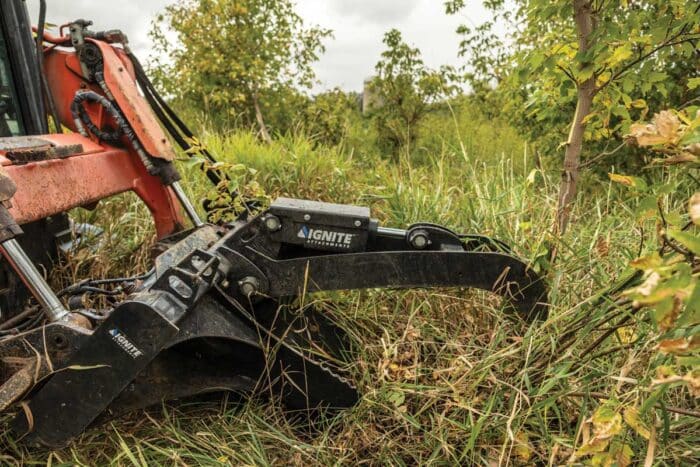
Once a project moves below ground, it’s time to stop thinking about cutting and start thinking about digging.
That’s where stump buckets shine.
While rotary mowers, brush cutters and tree pullers focus primarily on vegetation, stump buckets are designed to tackle what’s underneath. Their narrow profile concentrates breakout force into a small area, allowing operators to dig beneath stumps, sever root systems and pry out buried obstacles that would otherwise interfere with construction or landscaping work.
They’re commonly used during site development, utility installation, landscape renovation and land-clearing projects where complete removal is the goal. In addition to stumps and roots, stump buckets can be effective for removing rocks, old concrete and other buried debris.
Of course, the tradeoff is that stump buckets disturb more soil than other vegetation-management attachments. If the goal is simply to knock down brush or remove a few saplings, a stump bucket is probably overkill. But when a site needs to be completely cleared and prepared for the next phase of work, few attachments are more effective.
When evaluating stump buckets, contractors should pay close attention to construction quality. Reinforced gussets, high-strength steel and smart weight distribution all contribute to long-term durability and performance. A well-designed stump bucket should maximize digging capability while preserving as much of the carrier’s operating capacity as possible.
Build a Plan Before You Start
The most productive brush-clearing projects start by understanding the site and matching the right attachment to each stage of the job.
Walking up the site beforehand can help identify many of these challenges. Look for changes in vegetation type, signs of established root systems, hidden obstacles and areas where soil disturbance may need to be minimized. Spending a few extra minutes evaluating the property often saves hours once work begins.
It’s also important to consider carrier capabilities before selecting an attachment. Hydraulic flow, operating capacity, attachment weight and machine size all impact performance. The right attachment on the wrong machine can quickly lead to frustration and lost productivity. Working with a trusted dealer or using manufacturer compatibility resources can help ensure the attachment matches both the machine and the application.
At the end of the day, brush clearing isn’t really one job. It’s a series of challenges that often require different approaches as a project progresses. The right attachment at the right time helps contractors tackle each phase more efficiently.
Darin Gronwold is a product manager for Ignite Attachments.


Comments are closed here.