
How to Find the Right Snow Attachment for Your Compact Machine
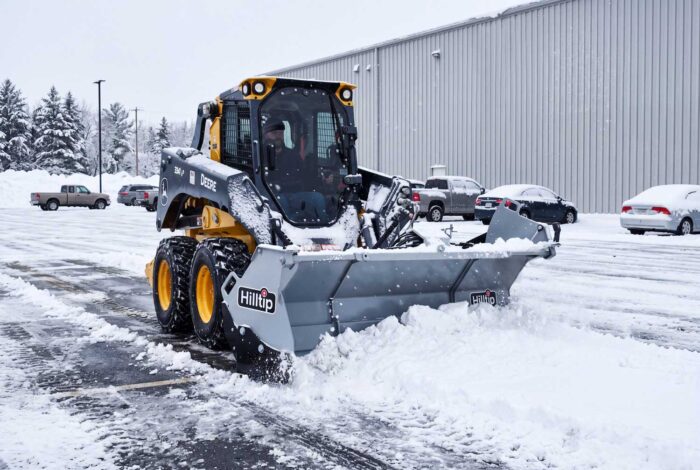
Winter maintenance professionals continue to expand their use of compact equipment for snow and ice control. From UTVs and compact tractors to skid steers and compact track loaders, today’s machines offer a combination of maneuverability, versatility and lower operating costs that make them ideal for a wide range of snow removal applications. Plus, with today’s pickup trucks representing a much larger capital investment than in years past, many fleets are reserving them for transportation rather than exposing them to the severe wear-and-tear inherent with snow removal applications — making these machines attractive options when winter strikes.
The key to maximizing productivity, however, is selecting the right attachment for the job. Different snow conditions, site layouts and equipment platforms call for different tools. A contractor clearing sidewalks and tight residential properties will have different needs than one maintaining large parking lots or distribution centers. Likewise, wet, heavy snow requires a different management approach than a light dusting.
Fortunately, compact equipment owners have access to a broad range of snow removal attachments, including straight-blade plows, V-plows, box plows, push brooms and rotary brooms. Understanding the strengths and limitations of each option can help operators improve efficiency, reduce equipment wear and deliver cleaner results throughout the winter.
Straight-Blade Plows: The Versatile Workhorse
The straight-blade plow remains one of the most common snow removal attachments for compact equipment. Its simplicity, durability and ease of operation make it a popular choice for UTVs, compact tractors, skid steers and compact track loaders.
Straight blades excel in general-purpose snow clearing. Operators can angle the blade left or right to windrow snow along driveways, roads, parking lots and access lanes. Because the attachment design is relatively simple, straight blades are often lighter than more complex plow configurations, making them especially well-suited for smaller machines.
For contractors managing mixed accounts, a straight blade provides an excellent balance of productivity and affordability. It handles light to moderate snowfall efficiently and can be used on everything from residential properties to commercial lots.
Modern plows also incorporate features that improve performance and durability, such as curved moldboards for better snow rolling, trip-edge protection systems that help absorb impacts with hidden obstacles and adjustable cutting edges designed to maintain a cleaner scrape while protecting pavement surfaces.
While straight blades are highly versatile, they are generally less effective in deep snow or when operators need to carry snow over longer distances. In those situations, a different plow style may offer greater productivity. For smaller carriers, lighter-weight plows built with high-strength materials can improve performance by reducing front axle loads without sacrificing durability.
V-Plows: Maximum Flexibility in Changing Conditions
For operators who encounter a wide range of snow conditions, V-plows provide unmatched versatility.
A V-plow can be configured in multiple positions, allowing operators to adapt quickly as conditions change. In the traditional V position, the plow slices through deep drifts and packed snow. In scoop mode, the wings move forward to contain and carry snow, reducing spill-off and improving efficiency. The plow can also be angled like a conventional straight blade for windrowing operations. This flexibility makes V-plows particularly valuable for contractors and municipalities that must respond to varying snowfall events throughout the season.
UTVs equipped with V-plows can efficiently clear sidewalks, pathways and smaller parking areas, while larger versions mounted on compact tractors, skid steers or compact track loaders can tackle more expansive commercial properties and roadways.
Although V-plows typically require a larger investment than straight blades, many contractors find the added versatility justifies the cost. One attachment can effectively perform the work of multiple tools, reducing equipment changes and improving productivity during storms. Just as importantly, operators should resist choosing a straight blade simply because it is familiar.
Applications with frequent drifting, confined spaces or repeated stacking often justify the added flexibility of a V-plow over the course of an entire season.
Box Plows: Built for Large Open Areas
When the goal is moving large volumes of snow quickly, box plows — commonly referred to as snow pushers — are often the preferred solution.
Unlike traditional plows, a box plow uses side plates to contain snow, allowing operators to push significantly larger quantities without losing material off the ends of the blade. This design makes snow pushers exceptionally productive in parking lots, industrial facilities, distribution centers and other large open spaces.
Skid steers and compact track loaders are particularly effective carriers for box plows because of their maneuverability and pushing power. Compact tractors can also be highly productive when paired with appropriately sized pushers.
For contractors responsible for large commercial accounts, a snow pusher can dramatically reduce clearing times. Rather than making repeated windrowing passes, operators can gather and transport large amounts of snow in a single pass, minimizing travel time and increasing efficiency.
Expandable box plows take the concept a step further by allowing operators to hydraulically widen or narrow the working width to accommodate various jobsites. The side plates can also be retracted to act as a straight-blade plow when appropriate. This added flexibility enables one attachment to handle both open parking lots and more confined areas where maneuverability is important.
Push Brooms: Ideal for Light Snow and Surface Cleanup
Not every winter event requires a plow. In many regions, operators frequently encounter light snowfalls, frost accumulations and residual snow left behind after plowing operations. Push brooms offer an efficient solution for all of these situations.
These attachments use rows of durable bristles to sweep snow and debris from pavement surfaces. They are especially effective for removing thin layers of snow before vehicle traffic compacts the material into ice.
Push brooms are commonly used on sidewalks, pedestrian areas, parking decks, loading docks and paved commercial properties. They can also serve as valuable cleanup tools following plowing operations, helping operators achieve a cleaner finished appearance.
Another advantage is year-round utility. Outside of winter, push brooms can remove dirt, leaves, gravel and other debris, making them a practical investment for contractors seeking maximum attachment utilization.
Rotary Brooms: Precision Snow Removal
Rotary brooms elevate sweeping performance by using hydraulically driven brushes that actively rotate against the surface. This design allows operators to remove light snow more aggressively while also clearing slush, ice melt residue and fine debris. Rotary brooms are especially effective on surfaces where a clean finish is important, including sidewalks, pedestrian plazas or parking areas.
Year-round versatility is an advantage to rotary brooms as well. During warmer months, they can be used for street sweeping, construction cleanup and property maintenance.
While rotary brooms are highly effective for light snow and surface finishing, they are generally most productive when paired with other tools. Many operators use plows or snow pushers for primary snow removal and then follow with a broom to deliver a cleaner final result.
However, operators should ensure the broom matches the hydraulic capability of the carrier. Those looking to add an expensive auxiliary power unit to a UTV simply to operate a broom may be better off using a skid steer whose existing hydraulics can power the attachment while also taking on heavier snow-moving tasks.
Craig Sandmann is managing director at Hilltip North America.


Comments are closed here.