
Breaking It Down: A Closer Look at Blue Diamond’s Hydraulic Breaker Family
Hydraulic breakers don’t have a particularly complicated job description. Put the tool against concrete, asphalt or rock and start breaking. But what goes on inside the attachment — and how well the breaker is matched to the carrier — can make a big difference in productivity, maintenance and, ultimately, how much work gets done in a day.
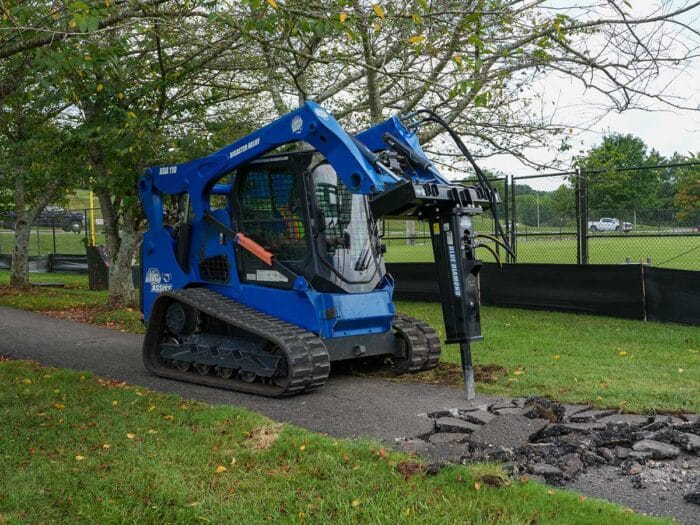
That thinking is behind Blue Diamond Attachments’ family of hydraulic breakers.
The lineup includes 12 models designed to cover equipment ranging from mini skid steers and compact track loaders to mini excavators and large excavators. Depending on the model and mounting configuration, the family accommodates carrier weights ranging from approximately 1,500 to 110,000 lbs.
That breadth matters because bigger isn’t automatically better when it comes to breaker selection. Hydraulic flow, pressure, carrier weight and the material being broken all factor into choosing the right attachment. Matching the breaker correctly allows the carrier and attachment to work as a system rather than asking one component to compensate for the other.
A Different Approach to Breaker Design
Where the Blue Diamond lineup gets particularly interesting is inside the breaker.
At the center of the design is a solid mono-block body that eliminates the tie rods found in many conventional hydraulic breakers. Tie rods hold together the major sections of a traditional breaker and operate in an environment where repeated impact is simply part of the job. Eliminating them removes a potential maintenance and failure point.
Blue Diamond takes that idea of simplification further, using only two internal moving parts on its breakers. Fewer moving components can mean fewer opportunities for something to wear, loosen or require attention — an important consideration for an attachment whose working life consists of repeatedly striking hard material.
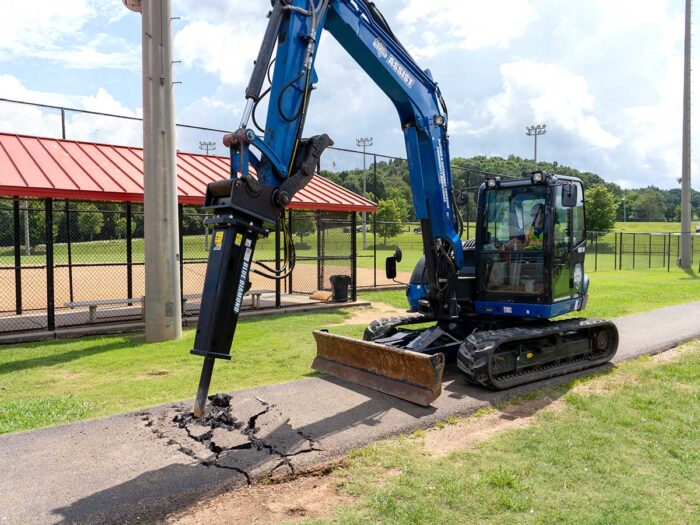
The breakers also operate without the need for nitrogen re-gassing.
None of this means breakers become maintenance-free. Far from it. Operators still need to pay attention to lubrication, bushings, working tools, hoses and proper operating technique. But designing out unnecessary complexity can make routine ownership a little easier.
Protecting the Breaker — and the Carrier
Durability isn’t just about adding steel. Managing the forces generated with every blow is equally important.
Blue Diamond breakers incorporate an anti-blank firing system designed to help protect internal components when the tool is not properly engaged with material. An energy recovery system captures recoil energy and redirects it into the next blow, while the poly case shell helps isolate noise and vibration.
Self-regulating valves provide another layer of protection by helping prevent over-pressurization. Body bushings surrounding the piston are designed to protect the mono-block housing should piston damage occur.
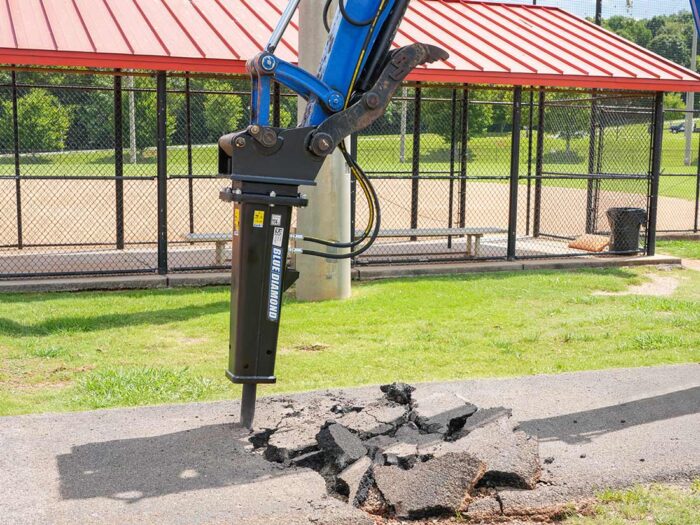
Taken together, those features address a basic challenge with any hydraulic breaker: delivering useful impact energy to the material without unnecessarily transferring destructive forces back through the attachment and carrier.
One Breaker Family, A Lot of Applications
The smaller end of the lineup opens breaker work to mini skid steers and other compact carriers that can maneuver into tight demolition, renovation and landscaping sites. Move up the range and skid steers, CTLs and excavators can tackle concrete removal, roadwork, trenching, rock excavation and larger demolition applications.
Interchangeable machine mounting brackets add another measure of flexibility, allowing contractors to configure selected breakers for different carrier types.
For contractors, that may be the biggest takeaway from the Blue Diamond breaker family. It isn’t simply about having a hammer that hits hard. The goal is matching the right breaker to the machine and then keeping that combination productive.
Because on a demolition or excavation job, breaking material is only part of the assignment.
Breaking through it and getting on to the next phase is what really matters. Learn more!



Comments are closed here.