
Considerations for Renting a Compact Telehandler
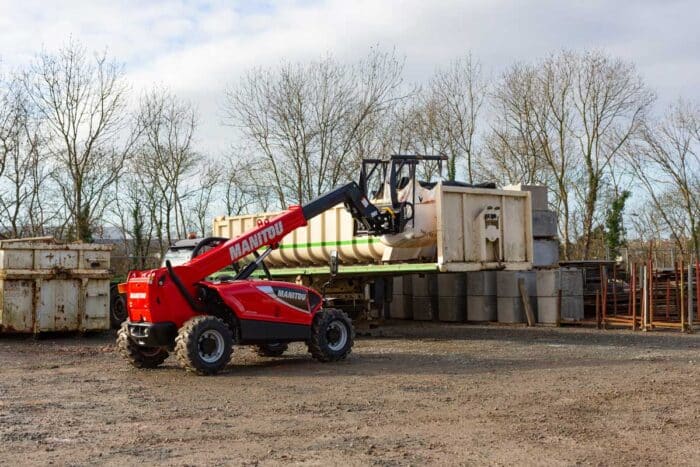
For construction, landscaping and agricultural applications, compact telehandlers offer versatility that can help improve efficiency on the jobsite. As an alternative to purchasing one of these machines, rental has become an increasingly popular option for contractors and farmers.
Rental provides access to new technologies without the risk of investing in a compact telehandler that may ultimately be underutilized. For renters whose needs may change from project to project, it also provides the ability to scale a fleet up or down accordingly. There are also financial advantages. Rental is often more cost effective than buying, as it eliminates the responsibility for maintenance, repair and storage, which instead falls to the rental company.
The fact that renting is also an operating expense instead of a capital investment is often appealing from a budget perspective.
Compact telehandlers are generally considered machines below 6,000 lbs and with capacities falling into the following ranges:
- Lifting height: 12 to 19 ft
- Outreach: 8 to 10 ft
- Width: approximately 4 ft, 11 in.
- Height: approximately 6 ft, 4 in.
- Engine power: 35 to 74 hp
- Turning radius: 8½ to 11 ft
Note: These capacities reflect Manitou compact telehandler models and may vary slightly by other manufacturers; however, they are comparable to other machines in the marketplace.
What to Consider When Renting
Safety is the most important factor when renting a compact telehandler. It’s mandatory that operators have the proper training, according to OSHA requirements under Standard 29 CFR 1910.178. Rental companies can assist with obtaining certification, which consists of a written test and hands-on training that covers proper operating procedures, as well as protocols for load handling and jobsite safety (e.g. awareness of ground and overhead obstructions, how to avoid general hazards, paying attention to other team members’ locations and more).
Along with proper training, inspecting the compact telehandler prior to operation is another important safety consideration. Renters should be certain that the machine is in working order and that they are familiar with the controls. If the compact telehandler will be operated in off hours, renting a machine with headlights is critical to safety. This feature offers the added advantage of extending working hours for greater productivity.
Important: Operators always need to wear their seat belt when operating a compact telehandler and stay inside the cab.
In addition to safety, there are several other factors to consider when renting a compact telehandler.
Application and attachments: The work to be completed drives the type of compact telehandler and attachments to rent, and rental companies typically have a variety of both in stock. Generally, compact telehandlers may have a universal attachment system that can connect most attachments to the machine to perform a variety of duties.
For example, on a construction jobsite, contractors may want to rent a snow blade to clear the site, a bucket to move dirt and a fork carriage to unload trucks and place bundled or palletized materials, staging them for handling by a crane or larger telescopic handler. In agricultural applications, a compact telehandler paired with a bale fork is ideal for stacking bales of hay, while a bucket can be used for moving feed to a mixer. If a landscaping company needs to move palletized materials, such as sod or pavers, they can add a fork carriage and forks to the compact telehandler to complete the job.
Ultimately, knowing what task is at hand will drive the decision about the attachments to rent to gain the most versatility and efficiency on the site.
Site access and constraints: Renters need to factor in the available space on a site, as well as access points. In a construction application, the machine needs adequate room to enter the jobsite, deliver and stage the materials, and move materials like lumber and sheet rock to the build itself. Understanding the dimensions and clearance of doorways and gates and factoring in overhead obstructions are also important in determining the best size of machine for the job.
Terrain: If the compact telehandler will be operated on rough terrain, it’s important to have a 4-wheel drive model that can maneuver over uneven ground. For landscaping applications where it is critical to avoid damaging grass, equipping the machine with turf tires is recommended. Likewise, if a construction contractor is working indoors on a new build, non-marking tires are helpful to avoid marks on new concrete slabs.
Diesel vs. electric: Compact telehandlers are available in diesel or electric models, and the rental selection depends on several factors. If a contractor is working outdoors and has access to regular fueling services, a diesel machine is a good option. Diesel compact telehandlers are less expensive to rent and often have telematics systems that can record the hours of operation, so renters can track fuel usage.
If the work to be completed is indoors or in low-noise areas, an electric machine offers the advantage of no exhaust and reduced noise levels. When working in urban areas, the latter can improve productivity by allowing contractors to operate the compact telehandler early in the morning or late at night without violating noise ordinances. The price point for renting an electric model is higher than a diesel model; however, some savings can be recuperated by eliminating the cost of fuel. When renting an electric telehandler, it’s important to have clean power that is not diverted to other vehicles or equipment to recharge the machine properly. Models are available for single phase 220V plug in, which is typically enough to recharge the machine overnight and provide roughly a four-and-a-half-hour runtime for the following workday. These electric machines also shut down when idling to conserve the charge.
Towing or delivery: Renters need to consider how to get a compact telehandler to the jobsite. For those who want to deliver the machine themselves, their truck and trailer must have the capacity to safely tow it. Consider both the weight of the compact telehandler (including attachments) and the weight of the trailer to calculate the total towing capacity. Conversely, many rental companies provide delivery services or have partners the renter can contact to transport the machine to a site.
Along with these considerations, choosing the right rental company is imperative. For both short- and long-term plans, look for a company with a solid reputation for its service and support. These companies are available to advise on the best compact telehandler and the attachments for the job, maintain the machines properly and provide replacements if necessary so renters can keep their projects on track.
Steve Kiskunas is a product manager for telescopic handlers at Manitou.


Comments are closed here.