
AI for Attachments Will Open a New World of Performance
Artificial intelligence has permeated our lives. Some applications are frivolous but some hold great potential, and attachments fall into that category.
What AI for Attachments Will Be Able to Do
Let’s start by understanding the concept of AI for attachments. The power of AI is found in its ability to synthesize output from a wide array of inputs. We eventually see AI for attachments having the ability to take input from the attachment, the host machine, the operator, the soil conditions, the project file, the weather and other influencing factors to control attachment performance in real time. With an auger on a compact excavator, for example, AI would begin with a soft start to reduce shock loads on the auger as well as the stick and boom. It would then dig aggressively, possibly varying auger rotation speed and downward thrust in response to changes in soil density or type such as loam on top to rock below grade. It would slow as the auger approaches the design depth, partly to reduce shock loads as rotation stops at the end of the bore but also to assure the operator that the AI recognizes the target depth is near and is responding appropriately. Once the target depth is reached, AI will reverse the rotation of the auger to clear the flights and withdraw the auger from the bore.
Operator assistance systems (OAS), such as the option to tailor control response to meet operator preferences, seem cutting edge now but will soon be relegated to history. AI will match control response to operator preferences and abilities and will vary those response curves to match conditions that change throughout the day. If AI senses the operator is becoming fatigued it will slow things down to maintain peak productivity while also preserving a margin of safety that might otherwise be lost to the operator’s slowed response times.
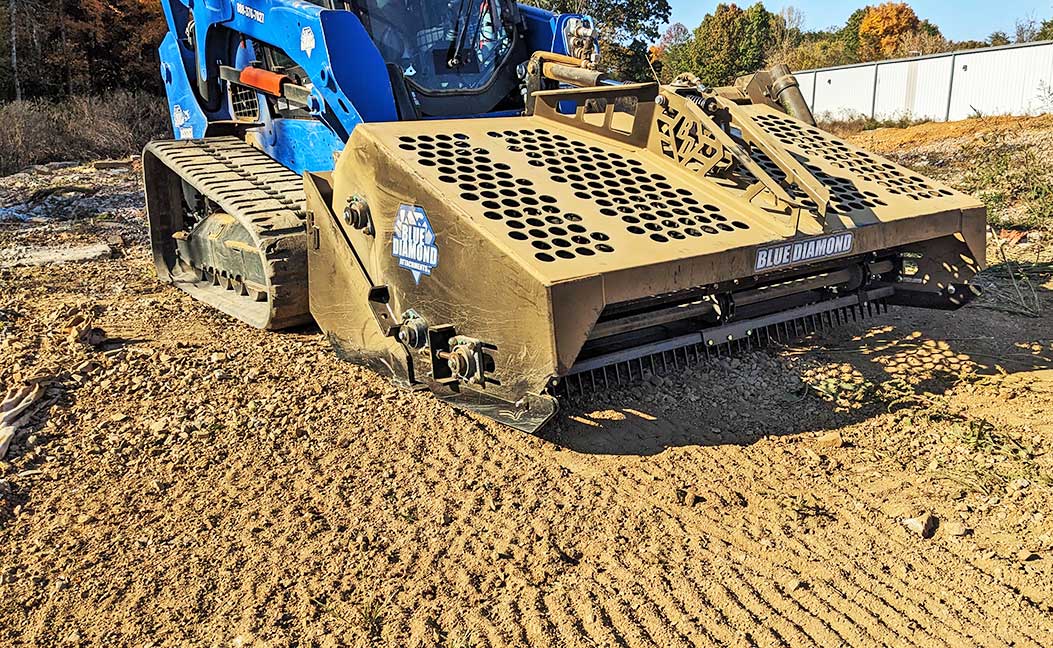
Response may be fast and aggressive at the beginning of a trench and slower and precise when the trench is being finished. The operator never has to go to the menu on the monitor; AI is automatically doing all this all the time. Or consider a power rake (aka Harley Rake). From the start through successive passes, AI will continually adjust the angle, rotation speed, depth and other factors of the rake while also optimizing ground speed of the host machine. Note that AI integration will be fullest on attachments run by auxiliary hydraulics rather than being self-powered.
AI will compensate for wear to cutting edges and teeth and other ground engaging tools (GETs) to maintain the precision those GETs had when new. Depending on many factors, bucket teeth may wear down and need to be replaced in 80 or 200 or 750 hours. Also depending on many factors, operators wear down in 4 hours and typically need to be replaced or restored by the end of an 8-hour shift. As with GETs, AI can track the wearing down of the operator and adjust machine and attachment function accordingly. It does this through reverse haptics (see the sidebar below) and even such subtle changes as how the operator is positioned in the seat with pressure sensors and where the operator’s gaze is fixed with eye tracking software.
Haptics in Reverse
One of the biggest challenges in the move from pilot to electric over hydraulic controls was to recover the tactile feedback required by operators. This feedback is called haptics and is the method by which operators remain aware of machine performance. AI will reverse that paradigm, sensing the operator’s touch at the controls to remain aware of operator performance.
AI will enhance safety with its predictive power. For example, current obstacle avoidance systems sense if there’s an obstacle within a certain distance of the machine. Some provide visual and audible alerts so the operator can take appropriate measures; some add an auto-stop function. Some differentiate between inanimate objects and persons. AI will know all that but will also have the ability to detect moving objects, whether equipment or personnel, and predict whether those moving objects will enter into the safety envelope.
Today’s technology has varying levels of integration but for all intents and purposes it is either an enabling or limiting mechanism taking its cues from a limited range of values. These are known as “dumb” systems and are defined by a lack of meaningful automation, reliance on operator inputs, reliance on basic sensors and limited functionality and integration. By contrast, AI is a “smart” system that is built on a coordinated decision-making architecture. It is objective-oriented. It has shared autonomy with personnel and systems. AI relies on “digital twinning,” where a digital replica of the job and all its conditions are provided to the AI. It takes input from as many sources as are provided to it and adjusts operations in light of those inputs. Control becomes fluid and negotiated between the AI, the operator and internal and external conditions (such as hydraulic fluid temperature and ambient air temperature).
What AI for Attachments Will Not Be Able to Do

Because AI is focused on objectives, it does not monitor for or report on data not relevant to those objectives. AI may note that the operator is not responding as quickly and is not sitting as erect in the seat as earlier in the day and modify machine responses accordingly. AI will not send a note to the supervisor saying, “Steve is tired.” AI does not remove the burden of responsibility from the persons associated with the job. If an excavator operator cuts a fiber optic line, “AI did it” is not a valid defense. Liability follows authority, not intelligence. An application of this is found in OSHA’s description of a “competent person” as defined on the OSHA website: The term “Competent Person” is used in many OSHA standards and documents. An OSHA “competent person” is defined as “one who is capable of identifying existing and predictable hazards in the surroundings or working conditions which are unsanitary, hazardous, or dangerous to employees, and who has authorization to take prompt corrective measures to eliminate them” [29 CFR 1926.32(f)].
There may be shared liability between the operator, the locate person and perhaps AI if it can be demonstrated conclusively that AI deviated from the script, but the mere presence of AI does not exonerate the humans. AI can support judgment, but it will not replace it where consequences are immediate and irreversible.
Despite the promise of autonomous worksites, AI will not replace humans. If they work at all, autonomous worksites will be production sites with mine trucks traversing haul roads to a common dump site and excavators loading each truck with three buckets taken from the same limited area. There are very few variables. Most applications requiring attachments have lots of variables. One critical area of variability is the discrepancy between utility maps, locates and as-builts and the in-ground reality. AI knows where everything is supposed to be but humans know where everything actually is. AI may have cameras and sensors feeding it but they are not reliable substitutes for simple human empiricism, the sense that all knowledge proceeds from sensory experience.
The final thing AI will not do is address the human element of work. Our work provides social context. It fulfills our need for meaning and purpose and delivers the sense of satisfaction that comes from a job done well. It teaches us conflict resolution and cooperation. It demands that we work together to define shared goals and then work together to achieve those goals. Work is an essential part of the human experience. In a culture focused on productivity and profit and materialism, the things that make humans truly happy are getting lost. AI can accelerate that loss but will not be able to correct for it. This is likely to become a top-of-mind topic in the coming years.
Hurdles to Overcome
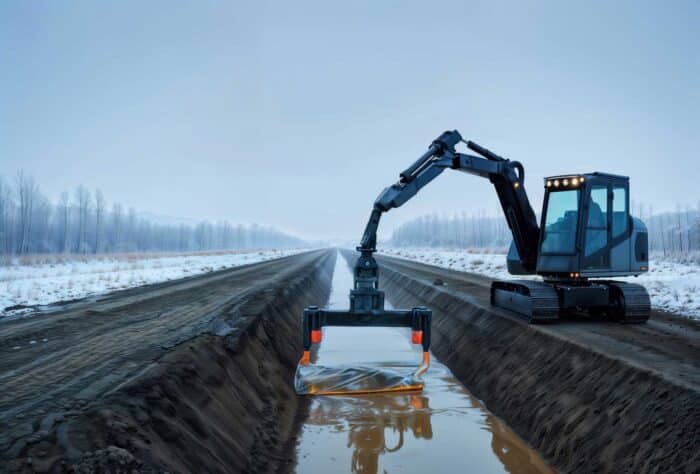
There will be a host of logistical issues to be resolved, but the construction and AI industries have demonstrated proficiency at this. The real challenge will not be in hardware but in conceptualization. Everything we have now is described by its physical nature. Skid steer plates and CII (common industry interface). Hydraulic flow and pressure. Pin grabbers. CANbus and ISOBUS architecture. But humans use semantics to understand language, derive meaning from communication and the physical world, and store and retrieve knowledge. It is the means by which we define concepts, categories and relationships. It is the language and symbols by which information is acquired, accessed, stored and shared, the means by which predictions are made and strategies are refined. AI relies on semantic technology.
What we know now about our equipment and attachments can be represented on a spreadsheet. What AI needs to know requires a discussion. Our current understanding tells us the hydraulic requirements of a breaker. AI tells us what that breaker can do, not just in terms of impact energy but as a contributor to the project, as a means of reaching an end goal. AI is ushering in not just a new way of doing things, but a new way of thinking about things. It is a force that will permeate every area of our lives, including attachments.
6DOF Defining Motion
A moving object has six degrees of freedom. In simple language these are up/down, right/left, forward/backward plus roll, pitch and yaw. AI can continually monitor the 6DOF of everything from a wheel loader to a tiltrotator and use that information to maximize productivity and safety.




Comments are closed here.