
Increase Your Productivity Flat-Out with Flat-Free Tire Options
Flat tires are a fact of life for many compact equipment owners, but that doesn’t make them any less frustrating. Whether it’s a skid steer on a demolition site, a forklift in a scrapyard, a wheel loader working around sharp aggregate or a compact tractor regularly enduring brush and stubble, damage can quickly derail productivity. Fortunately, flat-free and flat-resistant tire options continue to evolve, giving operators more ways to reduce downtime and keep machines moving.
The Real Cost of Flat Tires
On compact equipment jobsites, time really is money. When a tire goes flat, the machine is instantly out of service. Operators are forced to stop work, supervisors scramble to reshuffle tasks and productivity drops across the site. In many cases, a flat tire doesn’t just affect one machine. It can block access, delay follow-on work or create bottlenecks that ripple through the entire operation.
The direct costs are easy to see. Replacement tires are expensive, especially for heavy-duty applications. Service calls, emergency repairs and labor all add to the bill. The indirect costs can be even more damaging. Missed deadlines, frustrated customers and idle crews quickly eat into profits. Add in the physical strain on operators who are constantly dealing with tire problems, and it’s clear why so many equipment owners are looking for alternatives to standard pneumatic tires.
Why Pneumatic Tires Still Dominate
Traditional air-filled tires remain the most common choice on compact equipment for good reason. They offer excellent ride quality, strong traction and relatively low upfront cost. Air pressure can be adjusted to suit different surfaces, loads and applications, giving operators flexibility throughout the day.
The downside, of course, is vulnerability. Nails, rebar, scrap metal, thorns and sharp rocks can all puncture a pneumatic tire. Even slow leaks can cause uneven wear, reduced performance and eventual failure. In harsh environments, repeated flats are not a matter of if, but when.
Solid Tires: Maximum Durability, Minimal Flex
For operators who want to eliminate flats entirely, solid tires are often the first option considered. These tires contain no air at all, relying instead on a dense rubber construction to support the machine. The biggest advantage is obvious: solid tires cannot go flat.
This makes them popular in demolition, recycling, scrap handling and industrial applications where sharp debris is unavoidable. With solid tires, machines can work confidently in environments that would destroy pneumatic tires in short order.
However, solid tires bring significant compromises. They are much heavier than air-filled tires, which adds stress to axles, wheel motors and driveline components. Ride quality is also noticeably harsher. Without air to absorb impacts, vibrations are transferred directly to the machine and operator. Over time, this can contribute to operator fatigue and increased wear on the equipment.
Heat buildup is another concern. Solid rubber does not dissipate heat efficiently, and excessive heat is a common cause of premature tire failure in solid designs, especially during extended run times or higher-speed operation.
One development that reduces some of these concerns is the semi-pneumatic solid tire. These include specially designed apertures, or channels, that pass through from sidewall to sidewall throughout the tire to absorb shock, providing a much smoother ride for both the operator and the machine. Because these tires have less material, they are also slightly lighter and experience less heat buildup than traditional solid tires. This combination of improvements, especially the much-improved ride quality, make semi-pneumatic the preferred solid-tire choice for off-the-road applications.
Foam-Filled Tires: A Middle Ground
Foam-filled tires aim to strike a balance between pneumatic and solid designs. These tires start as standard air-filled tires, but the air cavity is injected with a foam compound that cures into a resilient material. Once filled, the tire becomes flat-proof while retaining the outer casing and tread of a pneumatic tire.
For many applications, foam-filled tires offer a practical compromise. They eliminate sudden air loss and allow machines to keep working even after punctures. Ride quality is typically better than a fully solid tire, and traction characteristics are familiar to operators used to pneumatic tires.
That said, foam-filled tires are not without drawbacks. The added foam increases weight, which can affect fuel efficiency and machine performance. The ride is stiffer than an air-filled tire, particularly over rough terrain. Once a tire is foam-filled, it cannot be adjusted for pressure or easily repaired, and end-of-life disposal can be more complicated and expensive.
Fighting Flats from the Inside
Another strategy focuses on protecting pneumatic tires rather than replacing them. Tire sealants and internal coatings are designed to seal punctures automatically as they happen. These products coat the inside of the tire and plug small holes caused by nails, thorns or other sharp objects.
For operations dealing with frequent minor punctures, sealants can dramatically reduce downtime while preserving the ride quality and performance of pneumatic tires. Operators can continue working without even realizing a puncture has occurred.
However, these solutions have some limits. Larger punctures, sidewall damage and severe cuts can still result in rapid air loss. Sealants also add weight and can complicate tire service. In extremely harsh environments, they may reduce the frequency of flats but not eliminate them entirely.
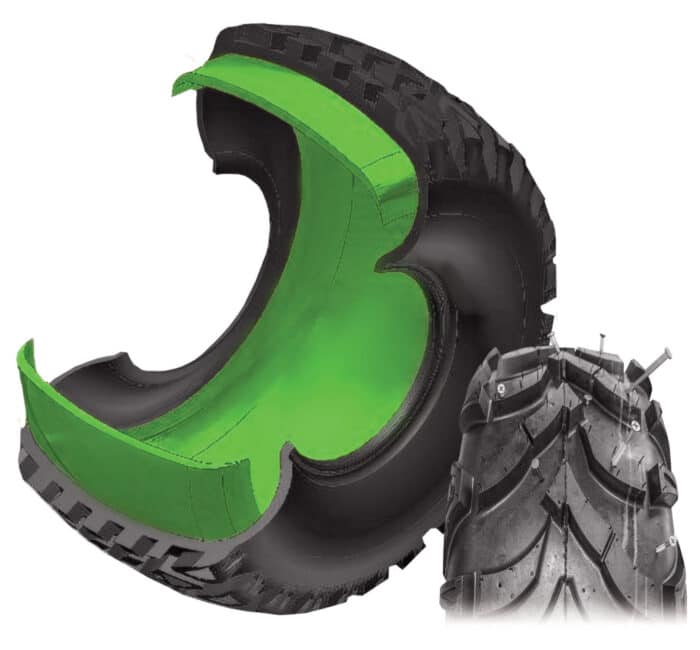
There are more advanced solutions available that reduce many of these concerns. Coatings such as TyrLyner offer a cured urethane rubber liner that’s bonded to the inside of the tire casing. It’s applied in a uniform layer that travels up a significant portion of the sidewall and can seal punctures and cuts up to ¼-in. in diameter, shoring up some of the sidewall damage concerns of traditional sealants. Furthermore, the treatment adds minimal weight to the tire (approximately 10 percent of the tire’s weight).
Newer Hybrid and Airless Concepts
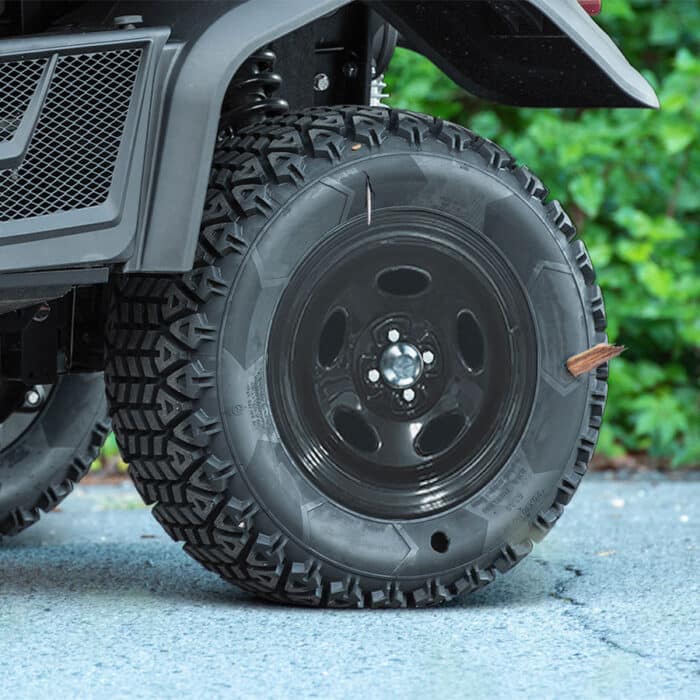
In recent years, tire manufacturers have been exploring new designs that aim to combine the best features of pneumatic and solid tires. These hybrid or airless technologies are designed to resist flats while improving ride quality, managing heat buildup and reducing weight compared to traditional solid tires.
Some designs rely on flexible internal structures rather than solid rubber to support the load. Others incorporate internal support systems that allow a tire to continue operating even if it loses air pressure. The goal is to keep machines productive without the harsh ride and heat issues associated with solid tires.
The appeal is clear. Operators get improved uptime and flat resistance, while maintaining better comfort and machine performance. These designs also tend to handle heat more effectively, which can improve durability in demanding applications.
Tradeoffs Still Apply
While these newer technologies are promising, they are not without challenges. Cost is often higher than conventional pneumatic tires, which can make adoption difficult for some fleets. Ride quality, while improved over solid tires, may still feel firmer than air-filled tires in certain conditions. Rolling resistance can also be higher, potentially affecting fuel consumption or battery life on electric machines.
Availability is another factor. Not all sizes, tread patterns or applications are covered yet, particularly in the compact equipment space. As these technologies continue to develop, options are expanding, but they are not yet a universal solution.
Matching the Tire to the Job
Choosing the right flat-free or flat-resistant tire solution depends heavily on the application. A landscaping contractor working on finished surfaces may prioritize ride quality and ground protection, making pneumatic tires with sealant an attractive option. A recycling facility surrounded by sharp scrap may find that solid or foam-filled tires pay for themselves through reduced downtime. Rental fleets often look for solutions that minimize service calls and keep machines rentable with minimal intervention.
Machine design also matters. Compact equipment is engineered around specific tire weights, diameters and compliance characteristics. Changing those variables can affect stability, lifting performance and component life. It’s important to ensure that any flat-free solution aligns with machine specifications and real-world operating conditions.
Steve Jensen is vice president of aftermarket sales at OTR Engineered Solutions.


Comments are closed here.