
How Mini Excavator Tech Brings New Hires Up to Speed Quickly
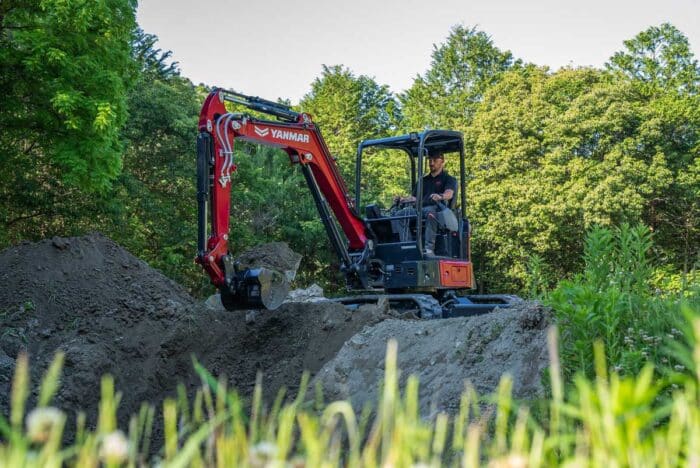
Mini excavators are prized for their efficiency and versatility, but getting the most performance and value from them requires skilled operators. It’s common for new hires with limited skills to be assigned to compact machines, including excavators. Modern technology is a key component in helping new operators acquire skill … but it’s not the only tool. The purpose in all of this is to attract, cultivate and retain the best talent available.
Training via Technology
In theory, mini excavators themselves can serve as tutors but “we have not yet seen a high volume of direct requests for machine-integrated training technologies,” says Eric Dahl, senior product specialist at Bobcat. He says large fleet owners and rental companies will likely be early adopters of this technology as it becomes available. Over time these tools will demonstrate their value, gain wider acceptance and eventually be commonplace components of standard training programs.
While integrated training features are not yet widely available in mini excavators, they are starting to make their way in, says Zac Evans, product manager at Yanmar. In the meantime, expanded information provides training and insight on discrete applications.
“For example, operators sometimes bump the emergency stop switch or incorrectly lower the hydraulic interlock lever prior to trying to start the machine and are met with a no-start situation,” says Evans. “To avoid unnecessary service calls, we now have a prompt in the display that tells the operator specifically which safety circuit is preventing the machine from starting and what should be done.”
Maintenance and service codes now include pertinent information, including level of severity. This used to require interpretation of dash lights or codes by the operator, but modern systems can provide more clarity on the issue and corrective actions needed through the advanced in-cab monitor.
Technological Assistance
There’s a full range of high-tech operator assistance tools in the marketplace and they all benefit both new and veteran operators, but not all of these tools filter down to mini excavators. Economics often play the deciding role. Pilot controls are less expensive than electric over hydraulic joysticks, but they also eliminate the possibility of variable response and sensitivity made possible by electronics. Advanced technologies, notably 2D and 3D machine control, are not standard and may not even be available as options.
Even when the bulk of R&D expenses in developing advanced systems has been amortized by inclusion in larger, more expensive machines, there are still costs of implementation, costs which are unacceptable percentage increases in the total cost of a compact machine.
All is not lost.
“We are incorporating electrohydraulic controls in some of our larger midi excavators,” says Ryan Anderson, product marketing manager at Case Construction Equipment, “and we are also investing in better 2D precision tools, making them easier to use and be more productive for entry-level operators.”
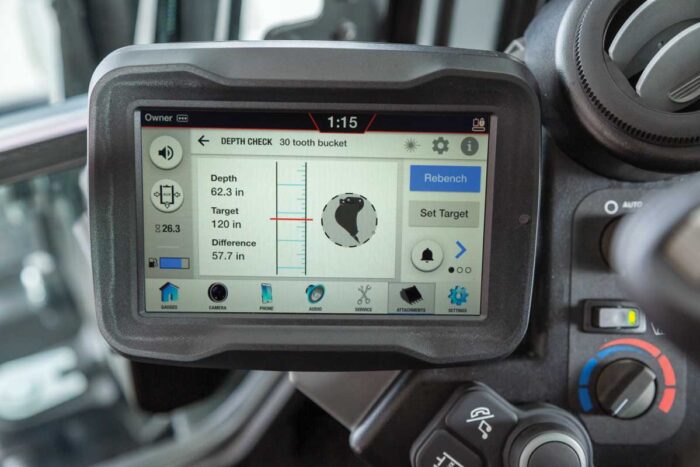
Manufacturers do an admirable job of compensating for the lack of high-tech options. Yanmar mini excavators use pilot controls, but intelligent design of those controls — especially the spools within the main control valve — makes pilot controls predictable and consistent to use. “Operators can further manage control response simply by varying engine speed,” says Evans. He says systems simpler than 2D and 3D machine control are helpful. Depth indicate is good for straight-line trenching and slope control is good for building slopes and contours.
Dahl adds that “One of the primary challenges for newer business owners, regardless of their age, has been justifying the upfront cost of 2D or 3D guidance systems. To address this, we focused on making our Bobcat Depth Check system both affordable and seamlessly integrated. It provides most of the features and capabilities found in traditional 2D indicate systems at a price point comparable to common options such as clamps and hydraulic quick couplers.”
Cameras help all operators maintain situational awareness. Rear view cameras are often standard. Optional multi-camera systems can provide 270- and 360-degree views. Proximity sensors are beginning to appear on compact machines. Adoption rates for these devices is lower for compact machines than for large ones. The better inherent visibility on compact machines makes the use case less compelling. Anderson notes that natural visibility to the sides and front with better hood slopes and window design provides a more effective vantage point.
One commonly available bit of helpful tech is a pattern changer. “For most models, an easy-to-access valve switch is available for easy pattern control changes,” says Anderson. “It isn’t used very often for owner/operators but certainly handy if the machine is run by a variety of different operators/crew members. And since rental is such a big market for mini excavators, having that flexibility is important.”
Pattern preferences are nearly split between ISO and SAE. “There are regional differences,” says Evans. “For example, backhoes historically used SAE and where they dominate the market, SAE is more popular in compact excavators.”
All operators value comfort, whether it’s the result of technology or design choices. Intuitive controls. Clear displays. Adjustable controls and seating. A larger, more open footwell. As for noise, vibration and harshness, OEMs continue to make gains and operators are often surprised at the resulting benefit. “You don’t realize it was a problem until you experience something better,” says Evans.
Beyond Technology
Evans’ advice to new hires: “Be a sponge. Have a learning mindset and be teachable.” He says a mentor is essential because of the immediate, real-time feedback on operator performance. Leaving a window open in enclosed cabs and reducing engine speed on any model can help ensure the trainee and the mentor have clear verbal communication with the trainer standing at a safe distance.
Trade schools and training programs at larger equipment dealers are good resources. Simulators and virtual reality (VR) systems can be part of these courses or work as stand-alone tools. These can all be part of the new operator’s training, where available, but they require time and planning so “operator’s manuals are the first step before approaching simulators and VR,” says Anderson. “The operator’s manual will show safe and proficient operation actions including how to dig and hoist. It will also identify what each button and function does.”
Social media can be a good place to learn. “YouTube is certainly a great option to help determine if getting a mini excavator fits your skill set and job task profile,” says Anderson.
Social media can provide insights, but not every person with a social media presence is capable of — or even interested in — teaching. Many aspire to become “influencers” and make a living off social media income. How to discern good channels? Find channels with good production value. Clear audio. Video with good lighting throughout and tight shots (close-ups) where required. Videos, especially longer ones, should have distinct sections and structure: A short intro, Step 1, Step 2 and so on, plus a thorough summary. Titles should read like subheads in textbooks, not clickbait. The video should not feel “puffed up,” which wanna-be influencers do to feed the social media algorithm. Procedures should follow accepted protocols, including safety.
Common Beginner Errors
Evans says beginner errors run the gamut. Too many passes. Too much rework. Not compacting backfill. Not optimizing machine positioning. “This is overcome with seat time. It’s all part of learning.”
Dahl emphasizes the value of feedback. “New operators sometimes hesitate to ask questions or ignore advice from more experienced hands,” he says. “Listening to seasoned operators can shorten the learning curve, help avoid common errors and build good habits that lead to more efficient work.” He adds that new operators can struggle if they underestimate the learning curve and enter the job with overly high expectations. “Understand that it’s normal for new operators to feel frustrated in the early weeks as they adapt to the machine’s controls and jobsite dynamics. True precision, smooth operation and jobsite awareness take time and repetition to develop.”
The Future of Mini Excavators
Our sources agree that AI will shape the future of these machines; they also agree the outcome is hard to predict. In some cases, it will be engineers and product designers using AI to address existing concerns and make further advances in specific areas they’ve been improving since long before AI became a thing.
But there’s some mystery to what AI will do. We don’t have the context to imagine what it might deliver. Engineers’ use of AI will be constrained by their habits and training. The really remarkable advances will probably come from visionaries willing to ask, “What if…?”


Comments are closed here.