
Detailing Boom Options for Mini Excavators
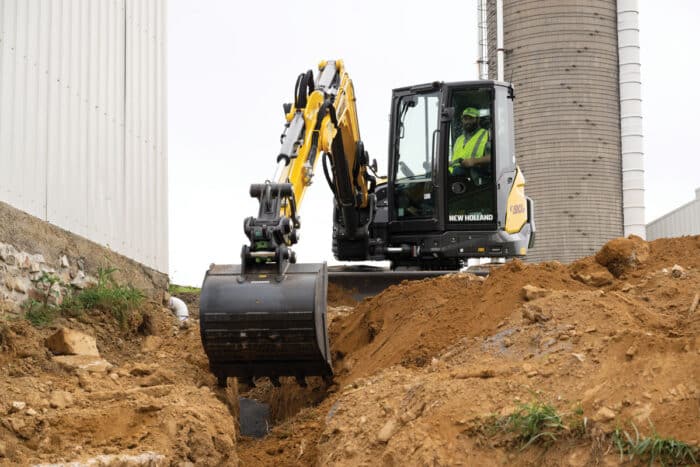
Mini excavators are remarkably versatile machines, and most are well suited with the standard boom. However, other options do exist — further expanding the versatility of these compact workhorses. We recently gathered insights about boom choices from two industry experts: Dan Kakareka, product marketing manager at New Holland Construction and Todd Cannegieter, product manager — attachments and special applications at Volvo Construction Equipment. While both mentioned some of the same points, each expert also provided unique details on boom options for excavators. Let’s take a look at what they had to say.
New Holland Construction
The current lineup of New Holland mini- and midi-excavators consists of a mix of C and D Series. They have two electric models. All models are zero tailswing.
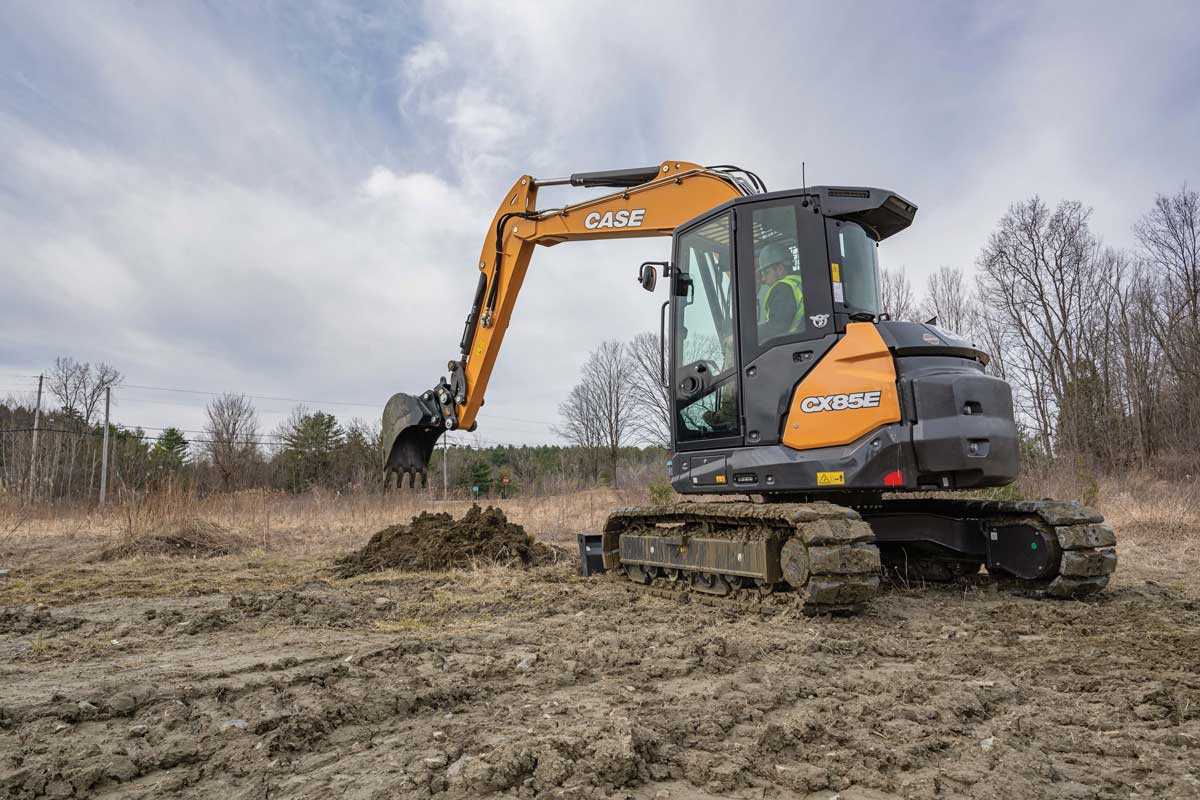
Kakareka says two-piece booms are more popular in Europe where jobsites are smaller and more congested. In North America, “We technically have two-piece booms available,” but the take rate is so low that virtually all compact excavators come with the standard mono boom. This meets the needs of most customers and greatly simplifies inventory control and exchange for dealers. There can be transport issues with two-piece booms as they don’t all fold down as low as a mono boom on a trailer, says Kakareka. It’s also easier to fit a mono boom model plus attachments onto a trailer.
New Holland does offer a standard and a long arm on all models. Long boom option models come with an additional counterweight that can be removed to regain zero tail swing functionality if needed. The long boom provides greater working range but less breakout force and lifting capacity.
The E85D is New Holland’s sole side mount, and it mounts to the operator’s right side. All others are center swivel. The range of swivel varies; for example, the E90D offers 85 degrees left and 53 degrees right while the E42D has 71 degrees left and 56 degrees right. The center swivel gives more reach and better access to the excavation, including the ability to dig a square box without moving the machine because the operator can dig in the footprint of the tracks. The side mount yields greater dump height, better visibility to the truck and better primary balance of the excavator. Again, the long arm is an option on all models, center swivel or side mount.
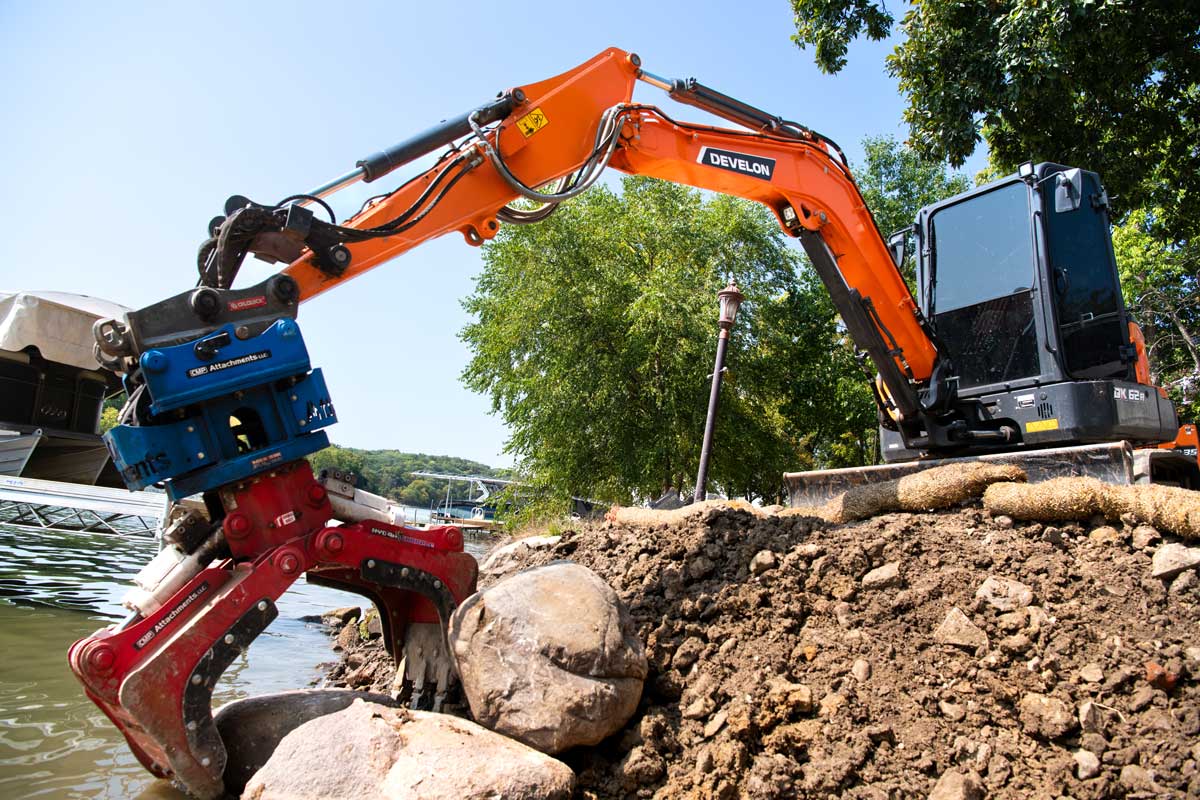
Compact excavators are hydraulic platforms for operators and New Holland’s offerings reflect this. Kakareka says while tiltrotators are more often seen on larger excavators, they are working their way down to 5- and 6-metric-ton machines. They’re more popular on center swivel machines in instances where both center and side mount models exist with comparable specs.
New Holland offers mulchers for machines down to 3.5 metric tons. The company’s D Series has first and second auxiliary circuits standard with optional third aux. There is also the option of a dedicated circuit with its own pump for mulchers. That option optimizes mulchers’ performance but is best suited for high utilization, otherwise a mulcher on the auxiliary proportional flow circuits will be fine.
There is no common industry interface; the closest thing is a hydraulic pin grabber. Excavator and attachment OEMs both have adapters. However, proprietary hardware can complicate the ability to find a suitable adaptor.
Mono booms rule the market because they have the lowest upfront and ongoing costs (fewer zerks, fewer wear points, etc.) but customers should consider the options before choosing. A mono boom may require repositioning the machine where a two-piece boom may allow the machine to do more work without repositioning — improving productivity and cutting costs. “Make sure to assess the job and the boom pairing.” Two-piece, telescopic and other specialty booms are often chosen for use in confined spaces or for demolition work and may be better suited to municipalities’ typical work. But Kakareka says a non-mono boom is more common on larger excavators than those in the mini and midi categories, where a mono boom performs well and provides excellent return on investment in a market segment that can be very price sensitive.
Volvo Construction Equipment
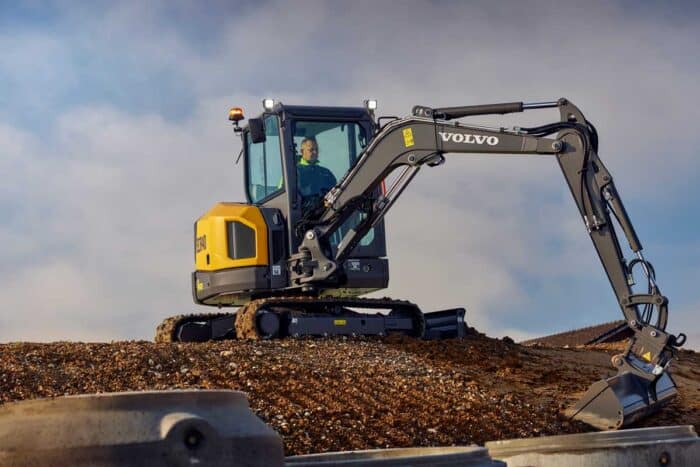
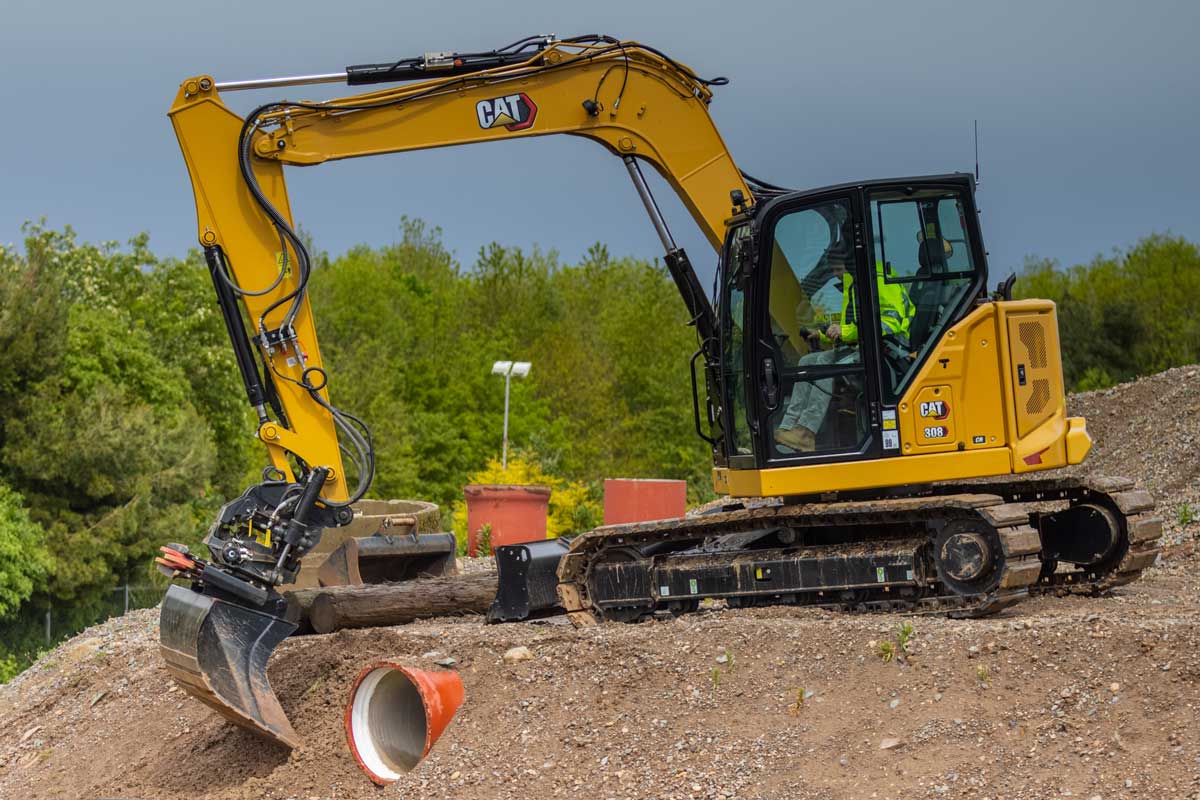
Cannegieter says Volvo also considers the mono boom to be the standard setup. “In general, mono booms are quite productive because they have longer reach, shorter swings and the ability to handle bigger buckets. They allow for the widest range of bucket sizes to be used and provide more reach and lift capacity at full extension than a two-piece boom.”
In addition to the more common angled mono boom, Volvo also offers a straight mono boom. “This is still a one-piece boom but doesn’t have that angle, so it provides more reach.” The EC300 and EC300 Straight Boom are examples of this design choice.
Two-piece booms, while less common, offer distinct advantages in certain applications, says Cannegieter. A two-piece boom can outlift a mono boom up close to the machine. This configuration allows you to change the bend of the boom to decrease its working height, which can be helpful in confined spaces. A two-piece offset boom knuckles off to the right or the left, which is helpful in tight spaces where your swing is more limited. When you line it up with one of the tracks, that side of the excavator can be right up next to an object or building. On bigger models this configuration will decrease lifting capacity. “Two-piece booms might be better for situations where space is limited, like under a bridge or indoors. And the offset configuration helps when you’re working in a confined space like a narrow alley or next to a road.” The two-piece and offset booms are popular choices on wheeled excavators.
There are long-reach and high-reach booms, mainly for mid-size and large excavators, but not generally for compact models. The long-reach is built to extend horizontally while the high-reach is intended for more vertical work. A long-reach boom on a larger excavator is helpful for tasks like dredging a pond or finishing a slope, where it’s not possible or safe for the machine itself to get close to the work. The leverage changes with this configuration, which typically means a smaller bucket, less lifting capacity and more need for a counterweight. A high-reach boom is mainly used for demolition. It usually has hydraulic joints and articulates for more precision. Counterweights are important for stability in this situation as well.
One of the first things to consider when determining your boom configuration is the maximum reach, height or depth you’ll be working at. Mono, long-reach and high-reach booms provide the best reach, but if you’re working in tight spaces, a two-piece regular or offset boom may be the better choice.
Lift capacity is another key consideration because overloading your boom will slow down movement, cause unnecessary wear and tear and burn more fuel. It can also cause safety issues by leading to tipping.
Hydraulic capacity is another important factor. If the machine can’t support the boom’s movement (including the weight and size of whatever you’re moving), that reduces efficiency and can cause maintenance issues. A handy feature some excavators offer is the ability to set up and save hydraulic settings for each configuration. This makes it quick and easy for an operator to select the proper flows and pressures, which is especially helpful if the machine will be used by multiple operators and/or they are less experienced.
Two-piece booms usually have higher purchase prices and additional maintenance points, so that’s worth considering too.
To help with total cost of ownership, look for excavator functions that support operator efficiency because that means less fuel burned and more predictable (and less costly) maintenance. Some excavators have automation functions that make boom movements smoother and more precise, which allows the operator to complete tasks faster and with less rework. Another helpful feature is the ability to set height, depth and swing limits. This prevents the operator from swinging into obstacles, lanes of traffic, ceilings, etc., and reduces unnecessary movement, which wastes time.
Check Out Two Boom Options from Takeuchi
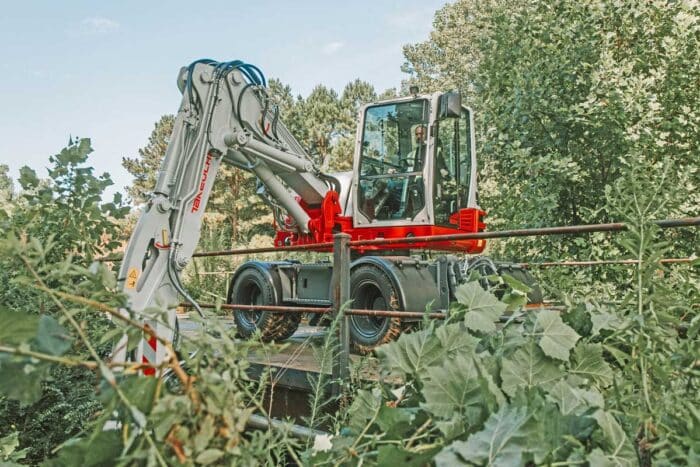
Takeuchi’s TB257FR features the company’s patented side-to-side boom, which allows it to dig offset over each track without being repositioned. Additionally, when digging offset, the rear of the machine and majority of the counterweight stay more in line with the machine’s center for enhanced stability. With the boom stowed over center, the TB257FR can nearly rotate fully within the width of its track, making it ideal for confined applications. The TB395W is a wheeled model that boasts a two-piece, heavy-duty swing boom which enables operators to dig further away from the machine and allows for closer digging when needed. The TB395W combines powerful excavating capabilities with a maximum dig depth of 13 ft, 5.2 in. and superior on-road performance, with speeds up to 18 mph. Together, the two models offer distinct advantages based on jobsite size, mobility needs and digging requirements.


Comments are closed here.