Wacker Neuson’s ST27: How a Super-Small Compact Track Loader Delivers Big-Machine Performance

In this Q&A, John Dotto, product application and training specialist at Wacker Neuson University, breaks down what makes the company’s smallest compact track loader such a standout. From the ST27’s compact footprint and impressive power-to-weight ratio to its innovative automatic two-speed drive, attachment versatility and operator-focused cab design, Dotto explains why super-small CTLs are finding homes on crowded jobsites, rental fleets and a wide range of applications where bigger machines simply won’t fit.
CE: First off, thanks so much for taking the time to talk to us today, John. We’re big fans of the Wacker Neuson brand. So, thanks. Let’s maybe begin by summarizing your smallest compact track loader offered today. Share major features, specs, technologies and options.
Dotto: At just 60 in. wide and under 80 in. tall the ST27 is smallest in the Wacker Neuson compact track loader line, but a true powerhouse. With a 74-hp engine pushing an operating weight of 7,350 lbs, this machine is pound-for-pound, best in class. It offers a rated operating capacity [ROC] of 1,890 lbs [at 35 percent of tip], it can do more than many heavier models. The vertical-lift ST27 also features a hinge pin height of 120 in.
What are the advantages of a smaller compact track loader vs. a bigger unit? Cheaper price? Easier to transport? Fits into more spaces? What are some disadvantages? Capacity? Lift height? What else?
The ST27 is proof that less can be more. The smaller dimensions, give operators greater opportunities for work in confined spaces, particularly with low overhang clearance and where maneuverability can be a challenge. The lighter weight means easier towing, making this an excellent machine for the rental market and for anyone with limited towing capacity. And although the 27 is slightly smaller, and lighter we still run a 74-hp Kohler diesel engine, which means the power to weight ratio on the 27 is insane. Additionally the Wacker Neuson lineup has a shared cab, meaning this little loader, has loads of cab space for an comfortable operating experience.
What are your major product differentiators? What makes your small track loader unique and better than everyone else’s?

In addition to industry-leading serviceability, the Wacker Neuson ST27 features innovative automatic 2-speed. This feature adjusts the speed range depending on the application and the operator’s joystick command movements. So, if the machine thinks you need to travel more quickly, it will kick into auto 2-speed. The new technology is a first in the industry and reduces the amount of input required by the operator. If that’s not an operator’s preference, auto 2-speed can be turned off for traditional push-button control.
Serviceability is one of our big-time differentiators. A simple engine compartment layout, top mounted swing up cooler and pod style cab are just a few features that contribute to a machine that is easy to understand, easy to work on and easy to keep clean.
The auto shift 2-speed is pretty unique, with up and down shift capabilities. That system can also be run more traditionally, if the operator prefers to shift with a button push.
Wacker Neuson CTLs cannot be operated without the seatbelt being fastened. We prioritize operator safety, and therefore we have an interlock system which will only allow the park brake to be disengaged when the operator is seated and buckled.
Where do these super small CTLs end up working? What types of applications are popular for the smallest subcompact track loaders?
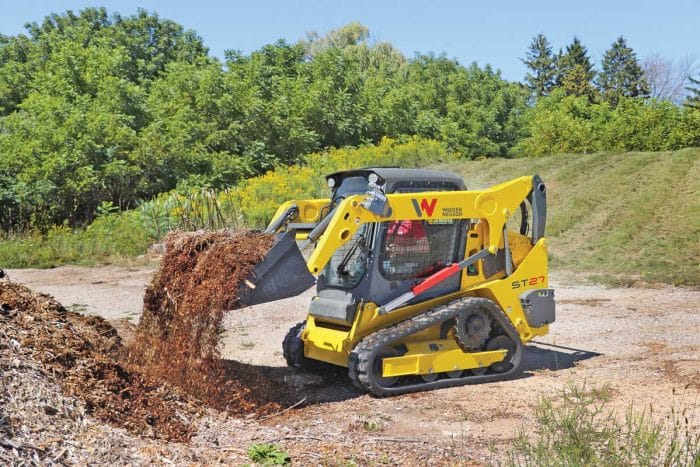
The versatility of small CTLs as tool carriers, as well as reduced ground pressure make them good candidates for applications in construction, agriculture, landscaping and tree service, as well as for rental. Small CTLs are the ninja of the construction world. Being light, nimble and flexible make them deployable in almost any application. But don’t sleep on their power, because when balanced with the properly sized attachments, a small CTL is the ultimate force multiplier for a contractor.
What is the auxiliary flow to attachments? Both flow and pressure? Is high flow available? What types of attachments do contractors often gravitate towards with these smaller units?
On the ST27, standard hydraulic flow rate is 19.4 gpm at 3,481 psi. High flow is available on the Premium Cab package and provides 30 gpm flow rate at 3,485 psi. Standard and specialty buckets and forks are typical, but ST27 becomes a multi-tool with augers, trenchers, brooms, Harley rakes, mulchers and breakers, as well as snow attachments.
What operational tips can you share when using smaller compact track loaders? Should contractors approach using these smaller track loaders differently? Are they easier to operate? Harder?
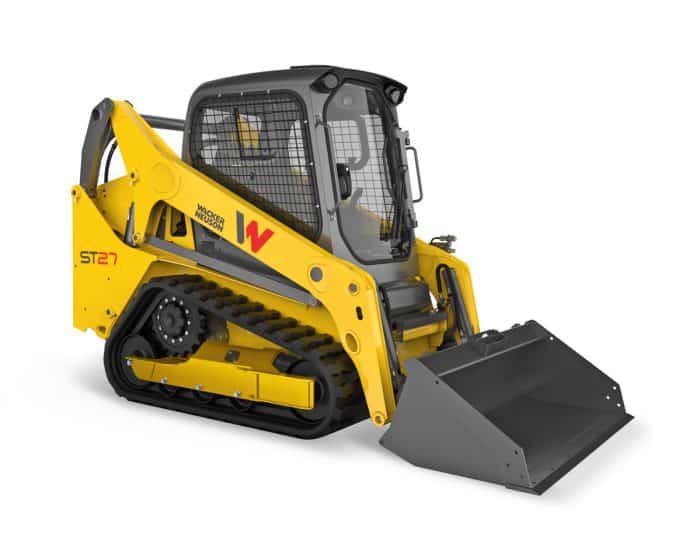
Operator comfort and safety are at the forefront of product design at Wacker Neuson, and the ST27 addresses both with EH joystick controls and panoramic visibility. EH joystick controls allow for low effort and adjustability to the operator’s preference in operating style or for the needs of a particular job. The large display makes it easy to adjust the joystick sensitivity and machine response settings for a fully customizable operating experience. From switch location and layout, to an angled foot rest in the floor board and the ergonomically located handles, joysticks and armrests, the cab is specifically designed to reduce operator fatigue.
Panoramic visibility that keeps the jobsite easily within line of sight of the operator, is a big benefit in small loaders. With low-profile loader arms, the design of the ST27 really opens up the visibility to the side of the cab. The vertical linkage on the rear of the machine is also designed to be out of the operator’s line of sight, maximizing visibility to the rear.
One of the things you’ll notice when running a smaller machine is that the overall machine footprint, the track on the ground and the machine weight need to be understood in order to maintain a safe balance on the machine. Side hills need to be approached with caution. Your pivot point on a shorter track base will be different than you’ll feel on a larger machine. In this case it’s not a one size fits all situation. Learn your loader’s limits and operate well within the limits that are defined as safe in your machine’s operators manual.
What advice would you give a contractor looking to buy or rent a smaller compact track loader?
When looking at the purchase of any CTL, consider where your equipment is engineered and produced. Has it been designed from the ground up to meet the challenges faced on jobsites all over North America at various times of the year? Are they developed and manufactured in the United States with the needs of the largest market for these machines in mind, including ease of serviceability? Look for an engine compartment that is engineered to be user-friendly with a simple, open design and efficient layout that requires less time on daily service checks and more time on the job, as well as complete access to all maintenance components.
Keith Gribbins is publisher of Compact Equipment.
Find out more about some of the largest skid steers on the market.