
Learn How Mini Skid Steers Excel in Tree Care Applications
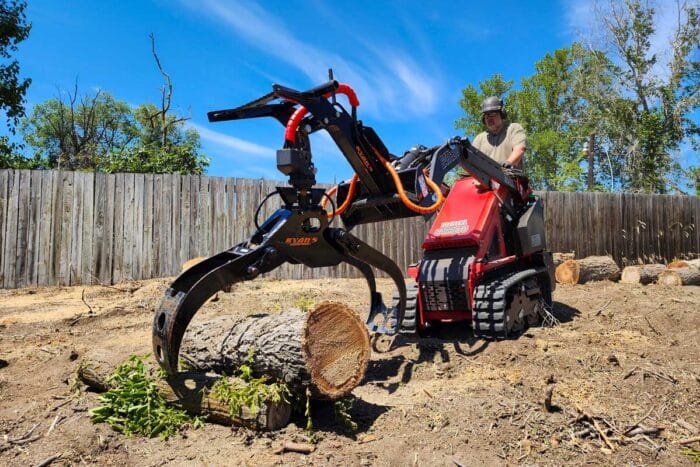
Mini skid steers are small, yet powerful machines that can reach spaces larger equipment simply can’t. They offer operators plenty of muscle and the ability to swap between countless attachments — helping to lessen the need for manual labor. All of these features make a mini skid steer (also called a compact tool carrier, mini loader, etc., depending on the manufacturer) a popular choice among tree care specialists.
“Tree care professionals work in environments that demand versatility, precision and safety,” says Matthew Valentine, director of sales for tree care products at Morbark, the owner of Boxer. “From residential backyards and urban corridors to storm cleanup and land clearing, crews often face tight access points, uneven terrain and heavy material handling. Mini skid steers — also known as compact tool carriers or compact utility loaders — have become a critical piece of equipment for tree care operations, offering a compact footprint with the power and flexibility to handle demanding tasks efficiently.”
If a tree care company is looking to add a mini skid steer to its fleet, it should start by working with a trusted dealer. A dealer will help the company determine the appropriate size machine for their needs. Kegan Strobel, product specialist for Vermeer tree care, rental and landscape equipment, explains that while larger, high-horsepower models are excellent for lifting and hauling material, they may not be suitable for a contractor’s typical jobsites. For example, if the tree care company routinely works in urban areas with tight access, a smaller machine may be a better fit. That’s especially important if getting through a 36-in. gate is necessary. Stability and lift path should also be considered.
“Radial-lift machines work well for digging and breakout at ground level, while vertical-lift machines provide better hinge-pin height for truck loading,” says Strobel. “Contractors should also operate a mini loader for an extended period before purchasing. Taking a quick ride around a dealer lot does not provide a good indication of what it will be like to operate that machine for an eight-hour day.”
It’s also recommended to choose a model that’s equipped with a universal attachment plate. Sarah Barreto, a marketing professional for Barreto, says this eliminates the need for brand-specific attachments and gives operators greater flexibility when sourcing any attachments they may need.
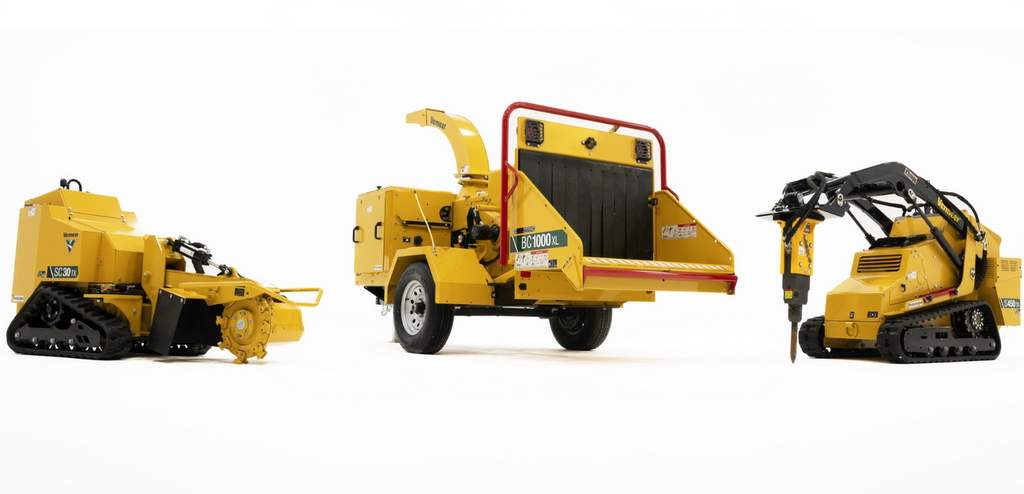
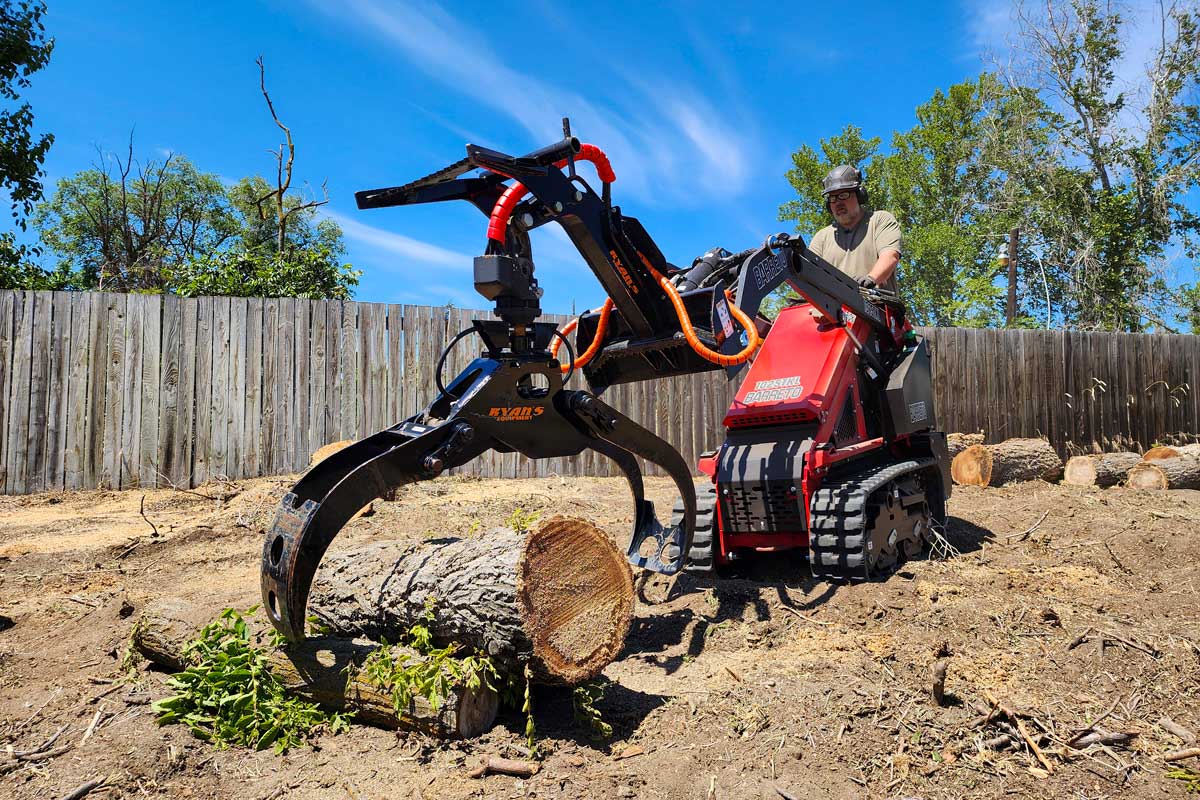
Speaking of attachments, grapples are considered a necessity when using a mini skid steer in tree care applications. These hardworking attachments are built to help grab, move and clean up logs, brush and branches. Strobel adds that mini skid steers equipped with a grapple attachment are frequently paired with a brush chipper. This allows operators to handle materials with the grapple and feed them directly into the chipper. Standard/general-purpose buckets are ideal for cleanup and support around the jobsite. A stump cutter/grinder attachment is another great option for tree care professionals.
“It attaches to a mini loader and is ideal for jobsites where stump removal is not the primary task,” says Strobel. “For example, if you need to remove a few stumps after clearing small trees and brush, a stump cutter attachment can help you efficiently remove stumps without having to wait on a rental stump cutter or another contractor. The attachment also saves trailer space on smaller jobs where a dedicated stump cutter is not needed.”
A Trio of Choices
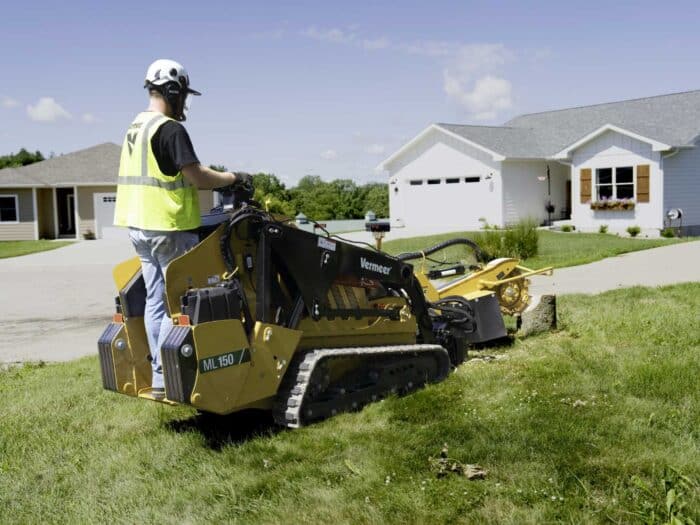
There’s no shortage of options when looking for a mini skid steer, but we gathered info on three models that fit the bill for demanding tree care operations. First up, Vermeer’s ML150. Strobel says the ML150 is built to handle hauling, digging and grading applications. It features a 1,530-lb rated operating capacity and a 40-hp turbocharged diesel engine. The machine’s vertical-lift path design provides optimal loading and dumping at height which is important when loading trucks and trailers on tree removal jobs.
“The ML150 features a chariot-style rear platform with cushioning and side padding to reduce vibration and operator fatigue over long shifts,” he adds. “A pilot-operated joystick provides smooth modulation for precise control. The ML series is backed by a 3-year/2,000-hour engine warranty and a 3-year/3,000-hour limited warranty on the loader arms.”
Barreto’s 1025TKL boasts a universal attachment plate, roughly 1,000 lbs of rated operating capacity and a wide variety of low- and high-flow attachment options — making it a great choice for tree care. It also offers easy upkeep.
“It’s the first of its kind to offer a cab-over design that your mechanic will love — making in-depth internal maintenance a breeze,” says Barreto. “It’s extremely robust and built with our signature Barreto durability. It also features our innovative track design that applies tension in both forward and reverse, preventing de-tracking in the field under challenging conditions.”
Thanks to Boxer’s 700HDX hydraulically expandable undercarriage, tree care professionals can safely fit through narrow gates while still maintaining stability when handling heavy loads. Valentine says this stability reduces the risk of tipping and improves operator confidence during demanding operations.
“Operators can retract the undercarriage to navigate passages as narrow as 34½ in., then expand it for increased stability during operation using a simple control lever,” he says. “This feature allows crews to work efficiently in confined spaces without compromising safety or performance.”
Operating Tips
Before getting to work on a tree care job, it’s important for crews to scope out the jobsite for any obstacles or unfavorable ground conditions. Also, crews should take the time to make sure everyone is wearing the appropriate PPE.
“Always wear eye and ear protection, boots, gloves, and use situational awareness for the safety of you and your crew,” says Barreto. “Have a plan for the jobsite. Note any tight spots or safety hazards and communicate those accordingly with your team. If the ground is wet and soft, consider your route accordingly.”
Mini skid steers have a tight turning radius which makes them ideal for working in many applications. However, Strobel says operators should avoid tight turns whenever possible, as they can damage soft surfaces such as grass and cause premature wear on tracks. He encourages operators to take turns more gradually to help minimize the need for restoration work and extend the life of the machine’s tracks.


Comments are closed here.