
Construction Unemployment Rates Improve in 33 States Year-Over-Year, ABC Says
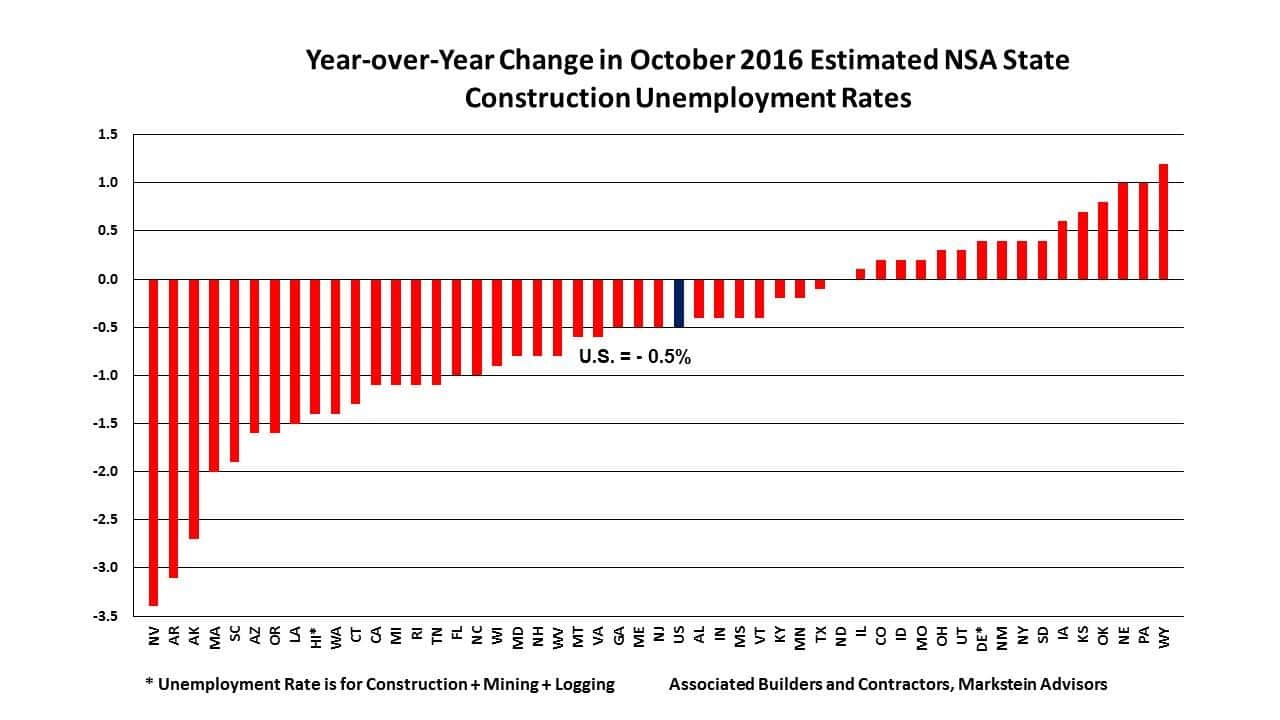
October not seasonally adjusted (NSA) construction unemployment rates were down in 33 states and the nation on a year-over-year basis, according to analysis released by Associated Builders and Contractors (ABC). The national NSA construction unemployment rate of 5.7 percent was down 0.5 percent from a year ago, according to data from the Bureau of Labor Statistics (BLS).
This was the lowest national October construction unemployment rate since 2006, when it was 4.5 percent. BLS data also reported that the industry employed 175,000 more people than in October 2015.
“October 2016 adds yet another month to the long-running streak of monthly year-over-year rate declines in the national construction unemployment rate that began in October 2010,” said Bernard M. Markstein, Ph.D., president and chief economist of Markstein Advisors, who conducted the analysis for ABC. “These industry-specific unemployment rates are not seasonally adjusted, so it is important to note states’ performance on a year-over-year basis. The improvement from last year in the national unemployment rate as well as in the rates of 33 states is a further indication that the construction job market remains healthy. Further, demand for skilled construction workers is especially strong.”
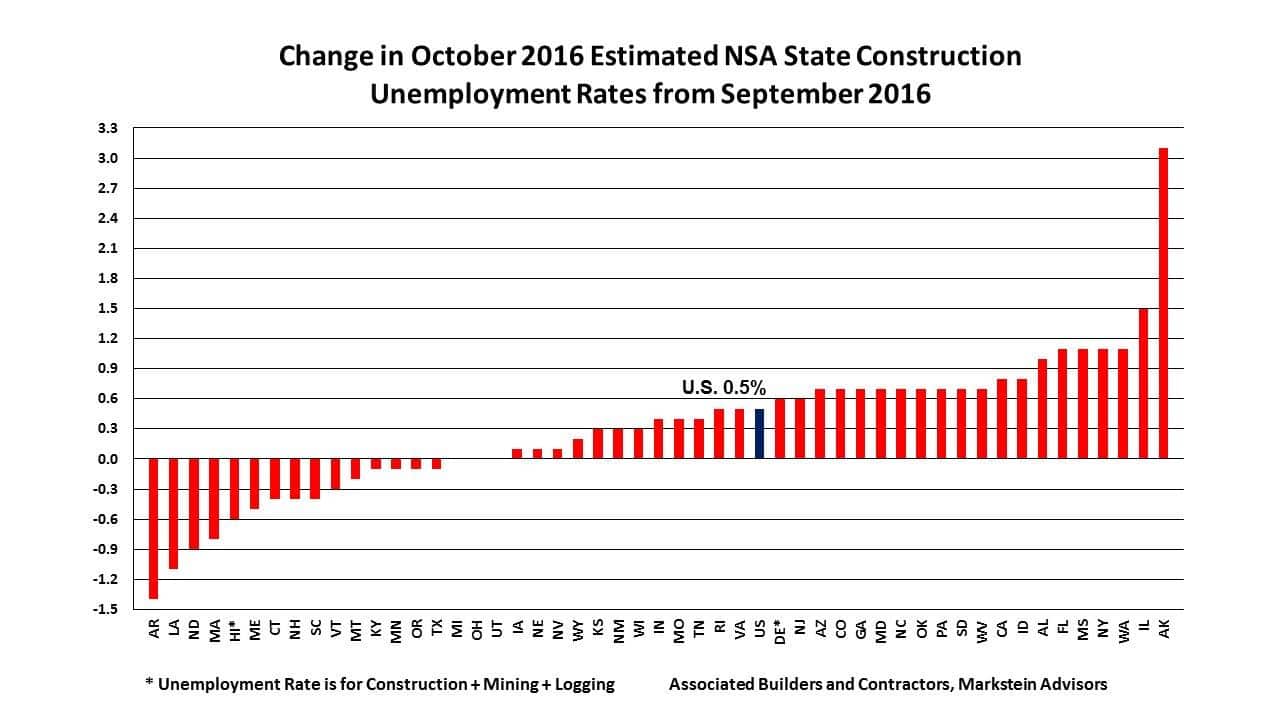
 For October, the historical pattern for change in the national NSA construction unemployment rate from September is for there to be an increase. Starting in 2000, when the BLS data for this series begins, through 2015, the October rate has risen 11 times and fallen five times from September. This year’s increase of 0.5 percent adds a 12th year during which the rate has increased from the month before.
Nonetheless, 15 states posted a decline in their estimated construction unemployment rates from September. Three states — Michigan, Ohio and Utah — had unchanged rates month-over-month. North Dakota’s rate was unchanged from October 2015.
View states ranked by their construction unemployment rate, their year-over-year improvement in construction employment and monthly improvement in construction employment.
View states unemployment rate for all industries.
 The Top Five States
 The Top Five States
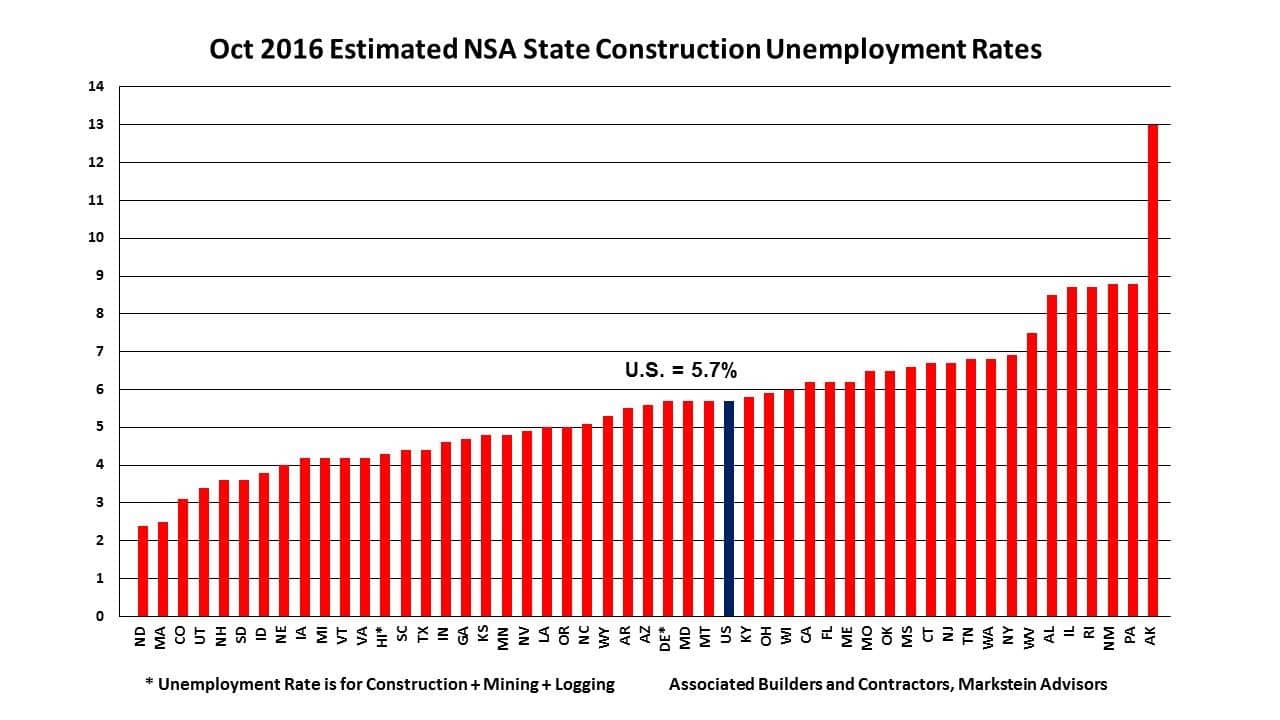
The states with the lowest estimated NSA construction unemployment rates in order from lowest rate to highest they were:
- 1. North Dakota
- 2. Massachusetts
- 3. Colorado
- 4. Utah
- 5. New Hampshire and South Dakota (tied)
Four states — Colorado, Massachusetts, North Dakota and South Dakota — were also among the top five in September. North Dakota had the lowest rate among the states in October at 2.4 percent. Construction employment in the state has been trending down since it peaked in October 2014, but it remains higher than it was prior to 2012. Massachusetts, with a 2.5 percent construction unemployment rate, moved up to the second lowest rate and had both the fourth largest year-over-year decrease (down 2 percent) and the fourth largest monthly decline (down 0.8 percent).
 Colorado dropped from the lowest rate in September to third lowest rate in October with a 3.1 percent rate, up from 2.4 percent in September and 2.9 percent in October 2015. Utah’s estimated NSA construction unemployment rate held steady at 3.4 percent, moving it from sixth lowest in September to fourth lowest in October. New Hampshire and South Dakota tied for fifth lowest rate in October, both with a 3.6 percent rate, a 0.4 percent drop from September for New Hampshire and a 0.7 percent month-over-month rise for South Dakota.
While only good for the 20th lowest rate, Nevada’s 3.4 percent year-over-year plunge in its construction unemployment rate to 4.9 percent was the largest decrease among the states and marked the state’s lowest October rate since October 2007 when it also stood at 4.9 percent.
The Bottom Five States
The states with the highest NSA construction unemployment rates in order from lowest to highest rates were:
- 48. Illinois and Rhode Island (tie)
- 49. New Mexico and Pennsylvania (tie)
- 50. Alaska
Four of these states — Alaska, New Mexico, Pennsylvania and Rhode Island — were also among the five states with the highest construction unemployment rates in September.
As in September, Alaska had the highest estimated NSA construction unemployment rate in October (13 percent), since these are NSA construction unemployment rates, Alaska’s ranking is not surprising and the state also had the third largest year-over-year rate decrease, down 2.7 percent. New Mexico and Pennsylvania had the second highest construction unemployment rate in October, a year-over-year increase of 0.4 percent for New Mexico and 1 percent—the second largest of any state — for Pennsylvania. Illinois and Rhode Island had the fourth highest rate in October, 8.7 percent. Illinois had the second largest monthly increase among the states, up 1.5 percent while this was Rhode Island’s lowest October rate since 2007, when it was 7 percent.
For more info from ABC, click this link. We promise meaty content.





Comments are closed here.