
Industry Experts Give Advice and Highlight Their Tiltrotators
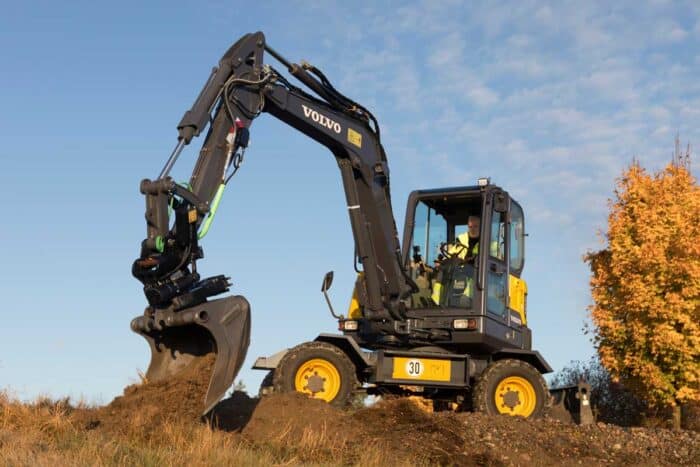
Tiltrotators on mini excavators are gaining popularity in North America thanks to the flexibility they provide. Operators appreciate that a tiltrotator allows buckets, grapples, brooms or forks to spin 360 degrees and tilt up to 45 degrees. So, instead of repositioning the entire machine, operators can precisely orient the attachment — cutting trench walls, grading slopes or laying material with pinpoint control. Without a tiltrotator, operators often have to move the entire machine to achieve a specific bucket angle. With one installed, that same operator can work faster and cleaner by staying put. This flexibility boosts productivity, reduces wear on the undercarriage and minimizes the need for extra crew members with shovels. Tiltrotators can also increase jobsite safety and simplify fine grading and utility work. Pretty cool, right?
To further explore these tools, we asked industry experts to give advice (ranging from selection to safety to operation) and provide a glimpse at a tiltrotator in their lineup. Scroll down to see what they had to say.
Caterpillar
Scott Britton, Marketing Manager
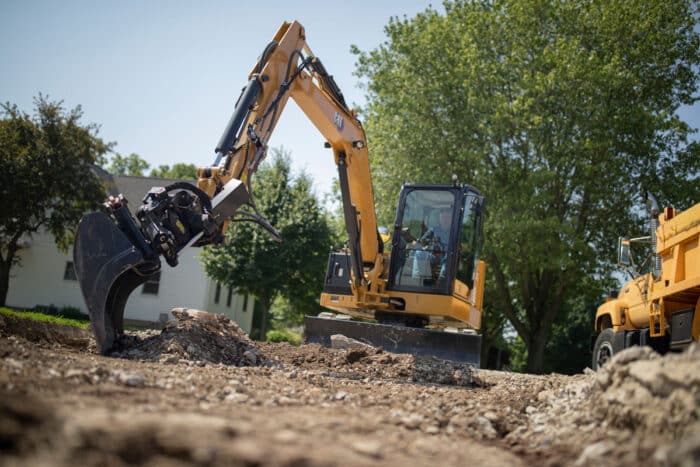
Advice: The size class of your excavator plays a significant role in determining which tiltrotator options are available. Larger machines typically support a deeper level of integrated technology, while smaller machines may have more limited functionality. It is also important to consider how the tiltrotator will be attached. Will it be permanently pinned to the machine’s stick, or mounted via a coupler so it can be removed when not needed? Safety features should be a priority as well. Look for OEM-supported systems that offer both visual verification and onboard monitoring to confirm proper coupler engagement. Machine integration is another critical factor. While tiltrotators are mechanically complex, their purpose is conceptually straightforward. The key question is how seamlessly the excavator communicates with the tiltrotator. Some systems are fully integrated with excavator OEM platforms, offering true plug-and-play experience along with established dealer support and diagnostics. Other solutions may require additional wiring, harness modifications or supplemental control modules to achieve similar functionality.
Product Spotlight: Caterpillar offers three Tilt Rotate System (TRS) models — the TRS4, TRS6 and TRS8 — for Cat 302.7 through 310 Next Generation mini excavators. These TRS models allow attached work tools to rotate 360 degrees and tilt 40 degrees side-to-side. This enables the machine to reach more work areas from a single position, while maneuvering tools over, under and around obstructions when excavating, grading ditches, sorting recycle materials or placing pipe. The TRS models multiply the mini excavator’s versatility and are available in various configurations to match the application. System design includes a top interface that connects the TRS to the carrier machine and a bottom interface that connects various work tools to the TRS. Top interface connections for the TRS4, TRS6 and TRS8 include a choice between an S Type hydraulic-coupler or pin on, while bottom interface options include the Pin Grabber or S type coupler. All TRS models are standardized with an auxiliary TRSAux1 hydraulic function at the bottom.
Takeuchi
Scott Utzman, Product Manager — Attachments
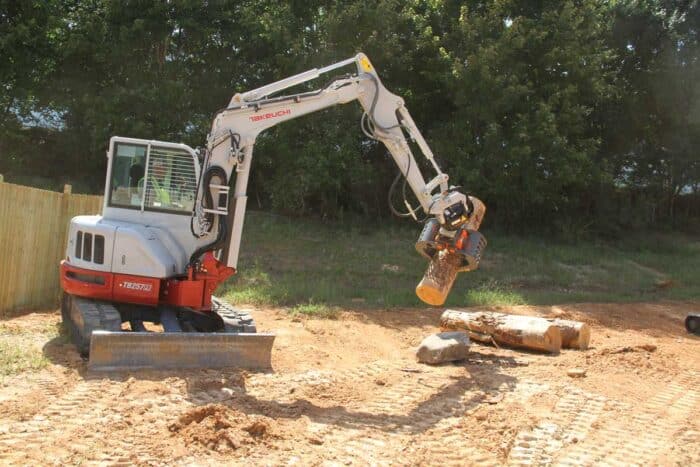
Advice: Safe, productive tiltrotator operation begins with a thorough pre-shift inspection. Operators should examine the tiltrotator, attachment interface and hydraulic connections for signs of wear, loose hardware or leaks. Attachments must be properly secured, and all cab controls and safety systems should be verified to ensure they are functioning as intended. Evaluating jobsite conditions — including ground stability, overhead hazards and the presence of nearby personnel — is also essential before work begins. During operation, smooth and deliberate movements are critical. While a tiltrotator increases versatility, it also requires coordinated use of the boom, stick, tilt and rotation functions. Keeping loads close to the machine, avoiding sudden or aggressive inputs and operating within rated capacities help maintain stability and control. Small, precise movements should be used to position the attachment accurately, rather than frequently repositioning the entire machine. Routine maintenance plays a key role in both safety and long-term performance. Maintaining proper hydraulic pressure, greasing pivot points daily and regularly inspecting wear components help ensure the tiltrotator continues to perform reliably on demanding jobsites.
Product Spotlight: Takeuchi’s tiltrotator attachment line includes both the DF4 and the Prop Plus models. The Prop Plus model is the most fully featured and functional in Takeuchi’s tiltrotator lineup. While other tiltrotators require multiple hydraulic circuits, the Prop Plus can run both tilt and rotate functions as well as a hydraulic coupler and multiple auxiliary functions using only the excavator’s primary circuit. Plus, there’s no need for a separate control box to toggle between those functions. The feature-rich Prop Plus kit includes two new joystick controls and a separate monitor. The Prop Plus can also work with a grading system if the need arises. The DF4 tiltrotator model runs its tilt and rotate functions using two hydraulic circuits and a control box located in the machine’s cab. This control box diverts flow to operate the hydraulic coupler and two auxiliary functions, such as a grapple attachment, for a total of five functions.
Volvo Construction Equipment
Darren Ashton, Product Manager — Compact Equipment
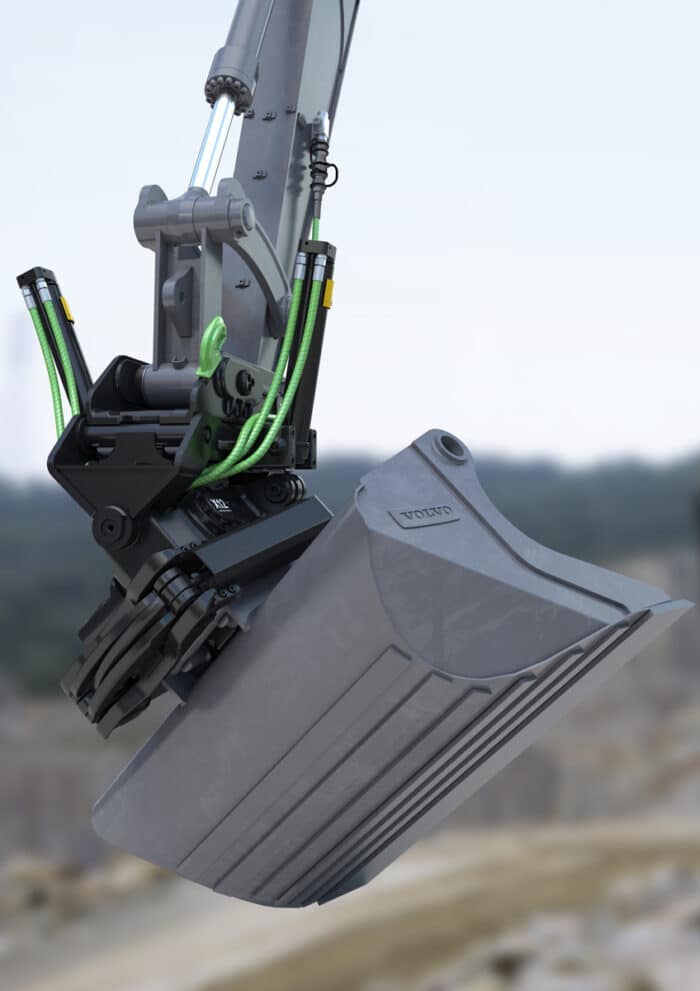
Advice: A tiltrotator allows an attachment to rotate 360 degrees and tilt 45 degrees, which is extremely helpful for complex tasks like finishing around manholes or utility boxes. The advantage is that you can do that work without repositioning the machine, saving a lot of time and fuel. To get the most out of your tiltrotator, make sure your machine’s hydraulics can handle its demands. Larger auxiliary lines will minimize pressure loss so you don’t sacrifice performance or cause unnecessary wear and tear. For instance, on our new EC65 and EW65, auxiliary flow is 100 percent higher; and on our new ECR90, it’s 15 percent higher. This higher flow plus increased horsepower and pump torque on all three models means the demands of a tiltrotator are no problem. For long-term durability, it’s best to have a quick coupler cast from high tensile strength steel to withstand the increased forces a tiltrotator applies.
Product Spotlight: Volvo CE offers Steelwrist tiltrotators for a superior combination of productivity, safety and precise control. These units feature a compact, low-build-height design that improves digging performance and fuel efficiency. Safety is prioritized through front pin lock technology, which prevents an attachment from falling even if a connection procedure is performed incorrectly. The positive/negative lock indication system displays green when secure and red when open. Steelwrist tiltrotators are compatible with a diverse range of attachments, including buckets, grading beams, pallet forks and sweepers.
GRYB
Erik Dynan, Senior Product Support Manager
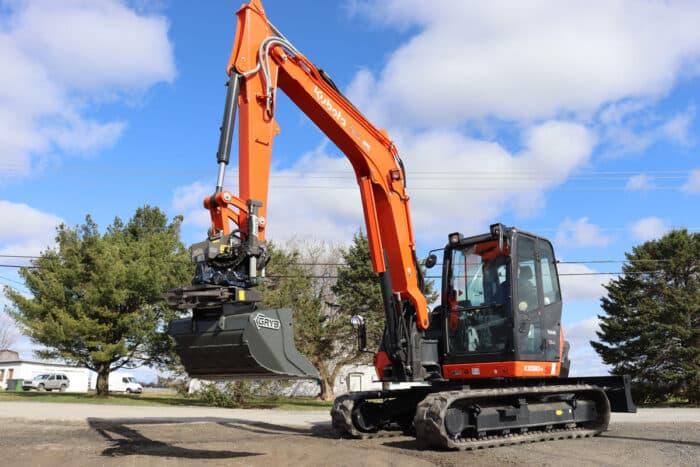
Advice: Operating a tiltrotator efficiently and safely starts with mastering smooth and deliberate control inputs. Before beginning any job, always conduct a pre-operation inspection; check for hydraulic leaks, worn pins, proper torque on fasteners, and ensure all coupler locks are secure. During operation, use the tilt and rotation functions to minimize unnecessary machine repositioning, which not only boosts productivity but also reduces ground disturbance and wear on the undercarriage. Maintain clear communication with ground personnel and establish safe exclusion zones when swinging attachments to prevent unintended contact. Always respect the machine’s load limits. Account for the weight of the tiltrotator and attachment when planning lifts to avoid tipping hazards. Familiarity with the full 360-degree rotation and tilt range enables precise work in confined spaces while keeping both the operator and nearby workers safer.
Product Spotlight: GRYB’s tiltrotators for compact excavators transform your machine into a highly versatile and precise tool for earthmoving, grading, landscaping and utility work. Designed with a grease-lubricated gear case, GRYB tiltrotators deliver infinite 360-degree rotation and ±40-degree tilt to handle attachments in virtually any orientation without repositioning the carrier machine. Mountable directly to the quick coupler or excavator arm, they are engineered for compact excavator classes and controlled easily via joystick and rocker switch for intuitive operation. Key features include load-holding cylinders, robust critical components, rotation and tilt sensors and an integrated grip module option for enhanced attachment versatility. These tiltrotators help operators perform advanced precision work quickly and efficiently from the cab while improving overall jobsite safety and reducing machine movement.
Ragnartech Inc.
TJ Hopkins, Director of Attachment Sales
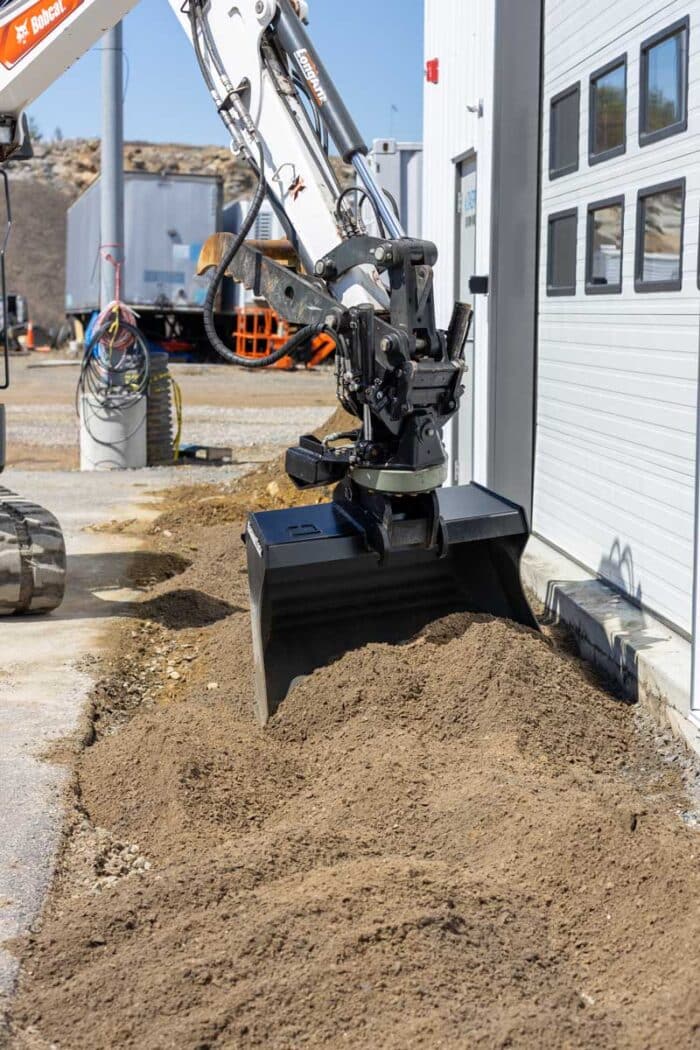
Advice: When selecting a tiltrotator, it is important to understand the limitations of each design. Some tiltrotators will rely on electronic components, and this will limit the end-user’s ability to work in wet or submerged conditions. Others will require multiple hydraulic circuits, and their design will conflict with your ability to have a thumb on the machine. Most tiltrotators will require you to use their buckets and coupling system, rendering your old buckets unusable while others require the tiltrotator to be directly pinned onto your machine. When making your choice, you should know which attachments are going to be used under the tiltrotator. If you only plan to use digging buckets, grading buckets or similar attachments, then a simpler and less costly tiltrotator may be right for you. It is always important to understand your load when operating any type of heavy machinery, as well as how your tiltrotator will affect your lifting ability and breakout force when used with an excavator.
Product Spotlight: At Ragnartech, we have eliminated the costly and troublesome electronics for tiltrotators on dual hydraulic circuit excavators. For single hydraulic circuit excavators, we have adapted an electronic diverter valve to allow for the tilt and rotation of your attachments. We have created tiltrotators specifically for mini excavators from Bobcat, Kubota and John Deere that allow you to use your current buckets without removing your thumb or OEM joysticks. Ragnartech offers multiple solutions for many different sized excavators at a lower acquisition cost than most tiltrotators on the market. All Ragnartech tiltrotators are assembled in New Hampshire.



Comments are closed here.