
A Practical Guide to Pallet Forks on Compact Wheel Loaders
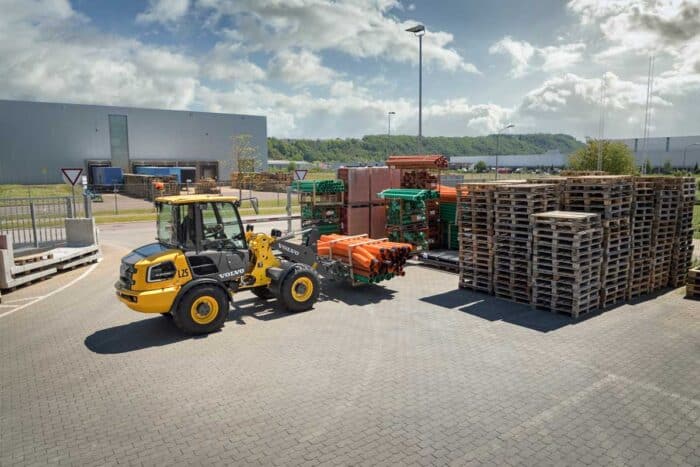
On most jobsites, the real work isn’t digging. It’s moving. Pallets of block, bundles of lumber, pipe, feed, fencing and bagged material all have to get unloaded, repositioned and placed efficiently. That’s why pallet forks have become one of the most-used attachments on compact wheel loaders, turning these agile machines into versatile material-handling tools across construction, rental, agriculture and municipal work.
“Pallet forks have a high ratio of use on compact wheel loaders,” confirms Aaron Kleingartner, construction attachment product manager for CNH. Often used to load and unload trailers, move pallets and large items around warehouses or lumberyards and move building supplies and barricades on construction sites, pallet forks are also commonly seen in ag operations, transporting hay bales or other materials. Darren Barnes, director of products at Blue Diamond, details some of the typical uses of pallet forks on CWLs:
- Load/unload pallets of brick, block, pavers, bagged material and jobsite supplies from trucks or staging areas
- Move and place bulky materials like lumber bundles, fencing, shingles/siding, pipe and landscape supplies
- Handle farm/municipal materials such as feed pallets, fertilizer totes and round or square bales (often with fork spacing adjusted wide or via sleeves/accessories)
- General site logistics: shifting loads around tight jobsites where a bigger loader or forklift doesn’t fit
Types and Sizes of Pallet Forks
There are a variety of sizes of pallet fork frame widths matched to machine sizing. “Be sure to check sizing suggestions on the pallet forks when reviewing for purchase,” Kleingartner cautions. “The fork frame not only interfaces with the machine, it holds the forks on a sliding frame, allowing width adjustment as well as [acting] as the backstop.”
Various fork lengths are available, based on application. Tine length depends on the application. Typical sizes range from 42 in. for 4K forks through 96 in. for 10K forks. Tine thickness ranges from 1-1/4 to 1-1/2 to 1-3/4 in. The most common tine lengths are 40 to 48 in., with capacities from 2,500 to 10,000 lbs. Most frames are about 60 in. “The quality of the tines — light, medium or heavy-duty — should be properly matched to the frame to support its lifting forces,” says Darren Ashton, product manager for compact equipment at Volvo Construction Equipment. Barnes breaks it down according to duty level, with capacity ranging from 5,000 (heavy duty) to 6,000 lbs (tall/extra heavy/severe duty and hydraulic):
- Key traits of the heavy-duty forks include reinforced brick guards, added plates in quick-attach systems, 4-in. carriage bars and side steps. They are available in walk-through styles and are “built for daily jobsite abuse,” says Barnes.
- Key traits of the tall-frame/D-ring heavy-duty forks include taller/heavier frames, built-in D-rings for tie-offs, high-visibility backrests set forward, massive bottom frames and bracing and side steps. They are designed for heavier loads and rigging needs.
- Key traits of the extra-large/extra-heavy-duty forks include oversized wide/tall frames (example: 51 by 44 in.), heavily reinforced brick guards and quick-attach areas, standard 48 by 1 3/4-in. tines (60- and 72-in. available). These are typically used on the largest skid steers and compact wheel loaders.
Beyond that, tines can be manual or rail-adjust, in which the forks lock in multiple positions. These reliable, economical tines are often standard on multipurpose models. Alternatively, in-cab hydraulically-adjusting forks, typically offered in 4,000- and 6,000-lb models, can save time. Typical range is ~8 to 40 in. on center for fork spacing. Another option are low-profile/non-floating tines that hook at the top and bottom (non-floating) for secure, low-profile work. Non-floating configurations reduce unwanted tine movement and increase load security. Frequently used on light/low-profile models, the tines lock to prevent movement. At the other end of the spectrum, carriage bars increase durability for heavy loads.
Putting It All Together
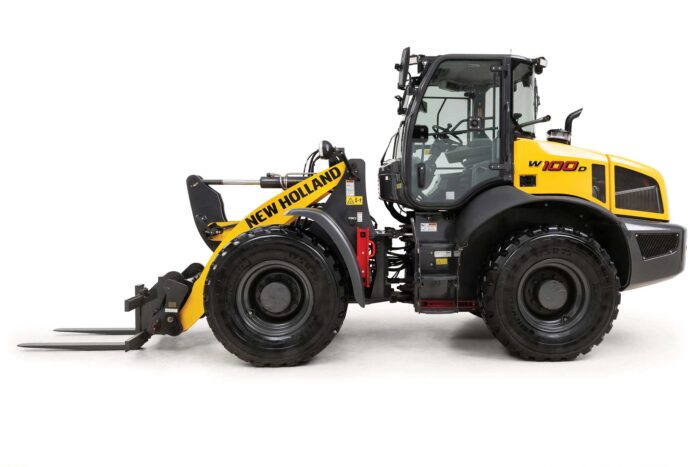
Compact wheel loaders, depending on the size, may use a traditional skid steer loader quick-attach, Kleingartner says. “Smaller units [think small articulated loaders] may be configured with a common industry interface, typical on mini track loaders. This provides a wide variety of options for easy attachment swapping for improved versatility.” The types of attachment plates commonly used on compact wheel loaders include:
- Skid-steer style “Universal/SSQA” coupler (aka Bob-Tach style). This style is common on CWLs.
- ISO-style wheel-loader coupler, a wheel-loader-specific quick-coupler that is offered on some compact models
Barnes says that 99 percent of pallet forks are ordered from the factory with the correct mounting system. To modify existing attachments or use conversion adapters for attachments across different machines, he suggests bare weld-on SSQA attachment plates, for about $270 to $420, depending on thickness/duty rating. Euro/Global to SSQA adapters run about $575 to $700 for standard duty. Heavy-duty Euro/Global to SSQA adapters cost roughly $1,400 to $1,900. Deere Hook-&-Pin/Euro to SSQA adapters commonly cost $575 to $650. Factory- or field-installed couplers are usually around $2,400 to $2,500 list price. “SSQA-equipped machines are the simplest and cheapest for attachment compatibility,” Barnes states. He cautions that using adapters adds weight and moves the load forward, thus reducing an effective lift. Fork frames mount via a quick-coupler or quick-attach system for fast swapping with buckets.
“Make sure you have the right coupler for your machine and attachment because not all brands can mix and match,” advises Ashton. “If your work requires multiple attachments, consider a quick-coupler for faster and easier swapping.”
Not only is it important to match the interface style to the attachment, but it’s vital to match the machine lifting capacity with the pallet fork sizing, keeping in mind the additional load center distance when determining available lifting capacity. Fork payload depends on load center and surface factors. Longer tines push the load center forward and reduce safe capacity.
“When using pallet forks, care should be taken for understanding the load center and lifting capacity of the machine. Carry the load low while traveling and position the load as close to the back-plate as possible. Pallet forks should not be used to pry. Never exceed rated lift capacity,” Kleingartner concludes.
Buying Tips
Spec the forks by the rated fork payload standards, not just the tine rating, Kleingartner advises. Payload is derived from full-turn static tipping load (FTSTL) or hydraulic limits. First, choose the fork carriage class that matches the machine’s payload range:
- Class II: 2,000 to 5,500 lbs at 24 in. load center
- Class III: 6,000 to 10,000 lbs at 24 in. load center
- Class IV: 10,000 to 17,500 lbs at 24 in. load center
Next, pick the tine length for what you handle most:
- 48 to 60 in. for pallets, block, bagged material and truck unloading
- 72 to 84 in. for lumber, pipe, big bundles and ag bales
- 96 in. only when machine is comfortably Class III/IV and jobs demand it
Barnes suggests that hydraulic walk-through models (4K or 6K), the walk-through/tall-frame heavy duty designs and the Class III 10K capacity designs provide unobstructed use around the loader arm and higher lift capacity as well as improved visibility. Depending on how you plan to use your loader, Ashton says, you may want high-flow hydraulics, which allow your attachment to operate to its full potential even under heavy loads.
“On Volvo’s newest CWLs, a hydraulic attachment bracket comes standard and a high-flow version is optional,” he says.
For multiple tasks, consider a model with the ability to set up and save multiple attachment settings. This makes it quick and easy for an operator to select the correct flows and pressures. “Our newest models also offer the ability to set height limits, which is great in a warehouse setting because it prevents the operator from bumping into anything overhead,” Ashton says. “You can also set a lift height if you’ll be lifting loads to the same height repeatedly. This automates the task, making the operator’s job easier and the machine’s movements more efficient. And finally, they include a self-leveling function so there is less concern about anything sliding off your pallet or fork.”
Ashton adds that Volvo offers an attachment with hydraulically adjustable width so you don’t have to swap out different forks for different tasks. Furthermore, he says Volvo’s 8-pin connector makes attachment setup easier from inside the cab.
The Right Forks Make the Difference
At the end of the day, pallet forks are only as effective as the machine and setup behind them. Matching fork class, tine length and frame design to a compact wheel loader’s lift capacity — and understanding how load center, terrain and attachments affect real-world performance — is what turns a common attachment into a true productivity multiplier. Spec’d correctly and used with care, pallet forks help compact wheel loaders move more material, work in tighter spaces and handle a wider range of jobs safely and efficiently.


Comments are closed here.